Most people buy a clipper first and shears last. That is backwards for the parts of the dog that scare you most. The face, the feet, and the sanitary trim are the three places where a clipper is the wrong tool and a sharp pair of dog grooming scissors is the right one, and they are also the three places where a dull or clumsy pair does damage in a single stroke.
I have groomed dogs for ten years, the last six out of a converted cargo van I park in driveways all over Austin. Faces and feet are scissor work every working day in that van, and the difference between a shear that cuts and a shear that crushes is the difference between a dog that stands still and a dog that never trusts you again.
This is how I keep shears cutting, how I test them before they touch a dog, and how to use them on a dog that would rather be somewhere else.
Why you should trust me
I started at 19 as a bather at a strip-mall salon. In my third week the only groomer quit mid-shih-tzu. The dog was half-pelted, the owner was already in the lobby, and I finished it with a 10 blade and a lot of patience. I have been finishing other people's dogs ever since. Now I run forty-odd dogs a week out of the van, mostly doodles, plus labs, goldens, huskies, and the occasional matted rescue that arrives in a trash bag.
Scissor work is the part of grooming that cannot be faked. I have owned the same pair of Geib Buttercut shears for years because they hold an edge through a full week of doodles. I finish heads with Kenchii thinners so the coat blends instead of showing lines, and I keep HASHIMOTO curves for faces and paws. I have also bought the cheap ones. FOGOSP chunkers are the budget surprise in my kit, and the Dream Reach set is what I tell home owners to buy, because you do not need my two-hundred-dollar shears to trim around a dog's eyes once a month.
How I picked and how I tested
Two tests decide whether a shear gets recommended in my book.
The first is the paper test. A shear should cut a sheet of copy paper cleanly from the pivot all the way to the tip, with no drag and no tearing at the last quarter inch. A shear that drags on paper will drag on a face, and a shear that drags on a face is how dogs get nicked. Run the paper test before every trim, not once when the shears arrive.
The second test is the tip. For home use, the tip has to be rounded. A sharp-pointed shear in the hand of someone who trims a dog twice a month is a puncture waiting for a head turn. Every professional pair I own has a sharp point because I have ten years of muscle memory, and even I have come close.
Everything else is about how the shear survives: the tension screw, whether the handles fit a hand that is also holding a paw, and whether the steel holds an edge or rolls after a few trims. I do not care what the box says about Japanese steel. I care whether it still cuts paper at the tip three months in.
Tools you'll need before you start
You can do a clean face, foot, and sanitary trim with two tools and no clipper at all.
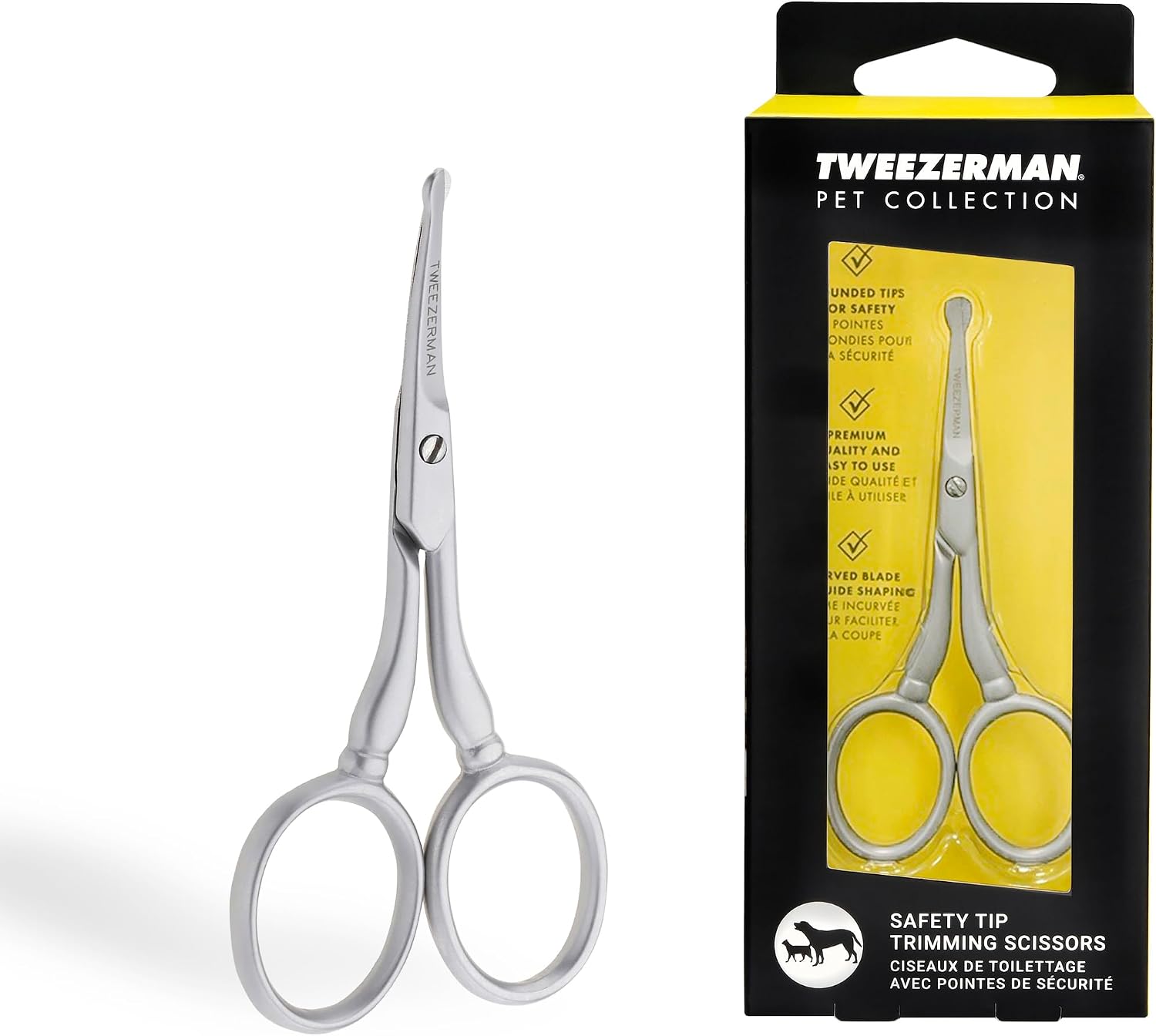
The pair I hand to home groomers: Tweezerman Pet Grooming Scissors-Rounded Tip Trimming Scissor for Dogs/Cats
 Visit on Amazon →
The rounded tip is the whole point of this pair, and it is why it is the one I put in a first-timer's hand. If your dog jerks its head while you are working near an eye, a rounded tip pushes instead of punctures. That single feature prevents the injury I have seen more than any other in this trade, and it is the one feature a pair of craft scissors from the kitchen drawer does not have.
The blade is short, which makes it a detail tool. It is for the hair between the paw pads, the fringe over the eyes, the feathering around the face, and the tidy-up work around the sanitary area. It is not a body shear and it will not clear a matted coat. Do not ask it to.
The short blade also means fewer hairs per cut, which is exactly what you want on a nervous dog. Small snips are recoverable. Big scoops are not.
Flaws but not dealbreakers: The small size means a full-body trim with this pair would take an hour, and the finger rest is minimal. If you are shaping a doodle's whole body with shears, you want a longer pair for the bulk and this one for the finish.
For a home groomer doing faces, feet, and sanitary trims between professional appointments, this is the pair to own. For a cat owner, the same rounded tip and small blade make it a sensible choice for a stray tuft behind an ear, though anything tight to the skin is a groomer or vet job, not a kitchen-table job.
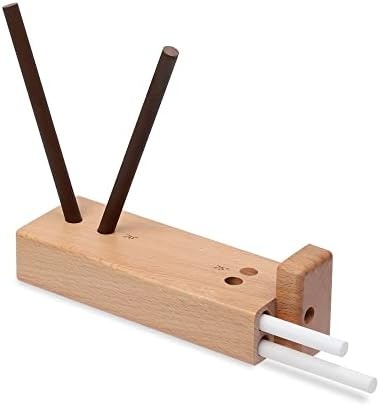
The touch-up tool: 4-Rod Ceramic Sharpener Box for Kitchen Knives and Cutlery Sharpening Tool
 Visit on Amazon →
Here is the honest version of this one: it is sold as a knife sharpener, and the part that matters to a groomer is the ceramic rod. Ceramic is a honing material, not a grinding wheel. A few light strokes along the existing bevel of a shear will bring the edge back when it starts to fold over, and that buys you weeks between professional sharpenings.
What it will not do is fix a nick, restore a badly rolled edge, or turn a cheap shear into a good one. If your shears are catching and pulling coat instead of slicing it, a rod will not save them. That is a sharpening job, and a proper sharpener is worth the money once or twice a year for any pair you plan to keep.
The rules I follow when I touch up an edge on a rod: use the fine rod, not the coarse one; match the angle the factory put on the blade instead of inventing your own; three or four light passes per side with no pressure; wipe the blade and run the paper test again. Press hard and you round the bevel, which makes the shear worse, not better.
Flaws but not dealbreakers: It is a box with four rods and no instructions written for shears, so you have to know your bevel angle going in. The base is light, so hold it steady with one hand while you stroke with the other.
For anyone maintaining a single pair of trimming shears at home, this is a cheap way to stretch the time between professional sharpenings. If you are a working groomer with six pairs in rotation, you already have a sharpener on speed dial and this is not for you.
The actual workflow
Now the part you came for.
Step one: set the dog up before you cut anything. Grooming on the floor is how backs get wrecked and dogs get cornered. Use a table with a belly strap or a grooming arm. If you do not have one, put the dog on a nonslip mat on a sturdy counter-height surface with a second person holding. A dog that is standing still and supported is a dog that does not jerk.
Step two: read the dog before you pick up the shears. A dog that is lip-licking, yawning, or showing the whites of its eyes is telling you the plan is too much. Slow down, do one paw, stop, and come back to it. That is not softness. It is the fastest way through a trim.
Step three: paper test the shears. Every time. Ten seconds, and it tells you whether you are about to crush coat instead of cut it.
Step four: comb the hair you are about to cut. Scissors on a coat you have not combed out will cut a line you did not intend. Comb the furnishings forward, let them fall back, and cut what is left.
Step five: trim the face with the tip pointing away from the eye. Hold the hair between two fingers, let the hair you want to keep sit between your fingers and the skin, and cut against your fingers. Your fingers are the guard. Cut with the tips of the shears, not the middle of the blade, and work from the outside of the face toward the nose.
Step six: do the feet flat. Hold the paw flat against your palm so the pads face you. Trim the hair that grows between the pads level with the pad, then trim around the outline of the foot. Poodle feet are shaved, not scissored, so if that is the look you want, that is a clipper job.
Step seven: sanitary trim, one small snip at a time. Work with the blade parallel to the skin, never pointing into it, and keep your free hand between the blade and anything soft. If the dog will not hold still for this, stop and use a clipper with a guard.
Step eight: clean and store. Wipe the blades with a dry cloth, put a single drop of oil at the pivot screw, close the shears, and put them back in their case. Shears that live loose in a drawer with a screwdriver and a nail file are shears that get nicked.
Step nine: check the tension screw. If the shears flop open when you hold them by one handle, tighten the screw a quarter turn at a time until they stay put when you open them to about 45 degrees.
What I did not put in this guide
Clippers, grinders, dryers, and brushes all show up in other guides on this site, and none of them replace a pair of shears for the three trims above. A clipper on a dog's face is how dogs end up with shaved whiskers and a nick on the cheek. A nail grinder is safer than a clipper on black nails, but it is a different tool for a different job. And no deshedding brush in my kit touches the coat that grows over a dog's eyes.
The one thing I will say about clippers here: if your dog has a matted coat, the answer is a clipper with a 10 blade and a conversation about brushing, not scissors. Scissors and tight mats are how dogs get cut. I have seen too many of those to pretend otherwise.
What this all costs
Both tools in this guide together cost less than a single salon appointment in most cities, and they are the two tools that keep every other tool in your kit working. The maintenance math is simpler than the buying math: a ceramic rod touch-up every few weeks, a professional sharpening once or twice a year, and a pair of trimming shears lasts a home groomer for a decade.
Compare that to replacing a cheap pair every time it stops cutting, which is what most people do. Three cheap pairs a year is more than one good pair plus a rod, and none of the cheap pairs will pass the paper test at the tip.
The short version
Rounded tip, short blade, paper test before every trim, comb before you cut, fingers as your guard, light passes on a fine ceramic rod between sharpenings, and a real sharpening once or twice a year. That is the whole system, and it is the same system I use in the van on forty dogs a week.
Your dog does not need a salon-grade shear. It needs a sharp, rounded, well-tensioned one, used in small snips, by someone who stops when the dog says stop. That is the job.