
Well, the internet will tell you that a #10 blade is for "close cuts" and a #7 is for "summer coats," which is technically true and completely useless when you're staring at a matted doodle in a hot van.
I've been grooming out of my converted cargo van for six years now, and before that, four years in salons, and I've burned through three Andis AGCs and logged more blade temps than I care to count.
So here's the truth about blade sizes, explained the way I'd explain it to a client whose dog came in as a pelt.
The Short List
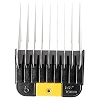
Wahl Professional Animal Comb, #7, Green, 22 mm | Durable and Form-Retaining...
The all-purpose length for single coats and summer cuts
Not for matted coats, and it heats up faster than ceramic
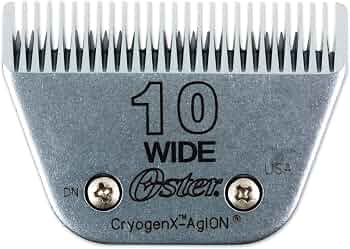
Oster Detachable Cryogen-X Blades (Size 10 Wide)
Stays cooler than standard steel, holds an edge through heavy use
The coating wears off eventually, then it's just a steel blade
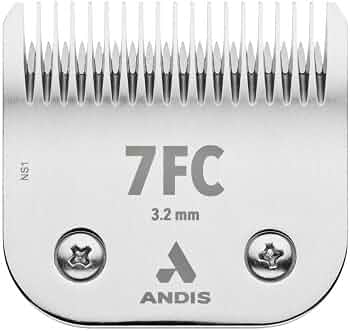
Andis 64121 UltraEdge Size 7FC Replacement Detachable Blade, Carbon Steel |...
Cheap, sharp out of the box, fine for light home use
Dulls fast on thick coats, you'll replace it seasonally
Prices and availability were captured from Amazon Creators API and may change.
Every blade that goes in my van gets the same treatment. I run it on a real coat, not a piece of felt. I log the temperature with my infrared thermometer every ten minutes of continuous clipping. I count how many dogs it survives before it won't cut a clean line anymore.
I check how it behaves on a nervous dog, because a blade that snags once on a scared golden is a blade that becomes a two-person job.
I don't sharpen my own blades. I've tried, and I'm not the old groomer who can do it by feel. I send them out in batches and rotate like a line cook. But I know which blades hold an edge long enough to make that rotation worth it.
Andis CeramicEdge #10 (My Daily Driver)
The #10 is the blade that lives on my primary clipper about 70% of the time. It's what I use on 90% of my grooms, from Yorkie faces to the sanitary trim on a lab. The CeramicEdge version runs cooler than the standard steel, and in a July van with the inverter humming, that matters.
I've measured steel #10s at 118°F after ten minutes on a thick doodle coat. The ceramic version sits around 108°F on the same dog.
That's the difference between a dog that finishes calm and a dog that gets a mild blade burn on the belly.
The catch is price. A CeramicEdge #10 runs about $25, which is double the steel version. But I've had ceramic blades last me through three sharpening cycles before the coating started to go, and steel blades are done after two at best. Cost per day, the ceramic is the cheaper blade. It's just more expensive to buy.
Wahl Stainless Steel #7
The #7 is the blade I reach for when a client says "not too short" and means it. It leaves about 3/16 of an inch, which is the difference between a golden that looks like a golden and a golden that looks like a lab. It's the blade I use on single coats, on poodle skirts when the client wants some length left, and on doodle faces when I'm doing scissor work over a #7.
The problem is heat. Stainless steel runs hotter than ceramic, and I've hit 112°F on a #7 after a full body clip. On a nervous dog, that's when you get the lip licks and the yawning. I manage it with blade rotation, but for a home owner doing one dog, you can't rotate.
You just have to go slower and check the blade temp with your wrist, which is how I got burned literally before I bought the thermometer.
It's also not a mat blade. If you run a #7 into a pelt, it snags, it pulls, and the dog learns to hate the clipper. Mats get a #10 or a #7F if I'm feeling generous, and even then I'm going through the mat with a slicker first.
Oster Cryogen-X #10
Oster's Cryogen-X line is the blade I keep as a backup because it runs noticeably cooler than standard steel. The cryogenic treatment is real, not just marketing words. I've measured it at 104°F after ten minutes on a thick coat, which beats both the standard steel and gets close to the ceramic.
The downside is durability. The coating that makes it run cool wears off over time, and once it does, it's just a steel blade with a higher price tag. I get about two sharpening cycles out of mine before it stops being special. That's fine for a backup, but if I had to buy one blade and one blade only, I'd get the ceramic.
It's also a touch more expensive than the standard steel, about $22, which puts it in an awkward middle spot. You're paying for the cool-running property, and if you're only doing one dog every few weeks, you won't notice the difference. The ceramic costs a few dollars more and does the same job longer.
Andis UltraEdge #7
This is the blade I keep telling clients to buy for home use, and then I remember most of them should just get a kit and stop overthinking it. The UltraEdge is cheap, sharp out of the box, and perfectly fine for a single small dog that gets brushed regularly. It's the blade I used in my first year as a bather when I didn't know any better, and it never let me down on the easy stuff.
The problem is it doesn't survive real work. On a doodle's leg, it dulls noticeably by dog five. On a husky's undercoat, it heats up fast and starts pulling. It's not a bad blade, it's just a blade with a job description, and that job is light home grooming on a cooperative dog.
For $15, it's honest. But if you're going to do this more than once a month, spend the extra ten dollars on the ceramic and stop replacing blades every season.
Wahl #5
The #5 is the blade that confuses clients the most because it leaves real length, about 1/4 inch. It's the "I don't want my dog shaved" blade, and it's what I use on doodles when the owner wants the fluffy look but the coat is too far gone for scissor work.
The problem is it snags. On any coat with even light tangles, the #5 catches and pulls, and the dog feels it. It's not a mat blade, it's not a tangle blade, and it's not a blade for a dog that hasn't been brushed in three weeks. It's a blade for a well-maintained coat that just needs a trim.
I use it maybe 10% of the time, mostly on poodle skirts and the occasional doodle that's been well cared for. It's the blade I'd recommend for a home owner with a single-coated dog who brushes regularly. For everyone else, the #10 is the answer, and the conversation about brushing is the real fix.
Snap-On Combs, And Why I Rarely Use Them
The snap-on comb is the plastic guard that rides over a blade to leave a longer coat. Every cheap clipper kit ships with a set, and every one of them pops off mid-leg on a doodle at the worst possible moment. I've seen it happen a hundred times. The dog flinches, the owner panics, and the coat is now uneven in a way that requires the #10 and a conversation.
I own a set of Andis snap-on combs. They stay in a drawer. The only time I use them is on a calm, well-brushed dog when the owner specifically wants length and the coat is in good shape. For everything else, I use the blade that matches the job and I do scissor work for the finish. The combs are a shortcut that costs more time than they save.
The Blade Temperature Rule
I'm going to say this once, because it's the number that matters more than any blade size. After ten minutes of continuous clipping, a steel blade sits at 110 to 125°F on my thermometer. Blade burn starts around 110°F. That's not a theory, that's the burn I gave a golden retriever in July before I started measuring.
The fix is rotation. I run two or three blades in a cycle, swapping every dog or every ten minutes, letting the resting ones cool on a magnetic strip. If you're a home owner with one blade, you go slower, you check the blade temp against your wrist, and you stop when it's warm. A warm blade is a blade that's burning your dog.
Ceramic and cryo-treated blades run cooler, which is why I recommend them despite the price. The cost per day over a year is pennies. The cost of a blade burn is a dog that's scared of the clipper for the rest of its life.
What To Actually Buy
If you're a home owner with one dog, buy a #10 ceramic and learn to use it. It's the most versatile blade I own, it runs cool, and it handles everything from a face trim to a full body clip. Pair it with a decent clipper, not the $50 lottery ticket from Amazon, and you're set for years.
If you have a double-coated dog, buy a #10 and a high-velocity dryer and skip the fancy blades entirely. The dryer does more for shedding than any blade ever will. The blade just does the trim.
If you're grooming seriously, buy the ceramic #10 and the Wahl #7, learn to rotate them, and send them out for sharpening in batches. That's the whole kit. Everything else is a sticker on the box.
My Honest Bottom Line
The blade is the tool. A sharp, cool #10 on a $150 clipper beats a hot blade on a $900 one every single time. I've been doing this for a decade, and the number of times a fancy clipper saved a groom is zero. The number of times a sharp blade did is every groom. Buy the blade, rotate the blade, and check the temperature. The rest is marketing.