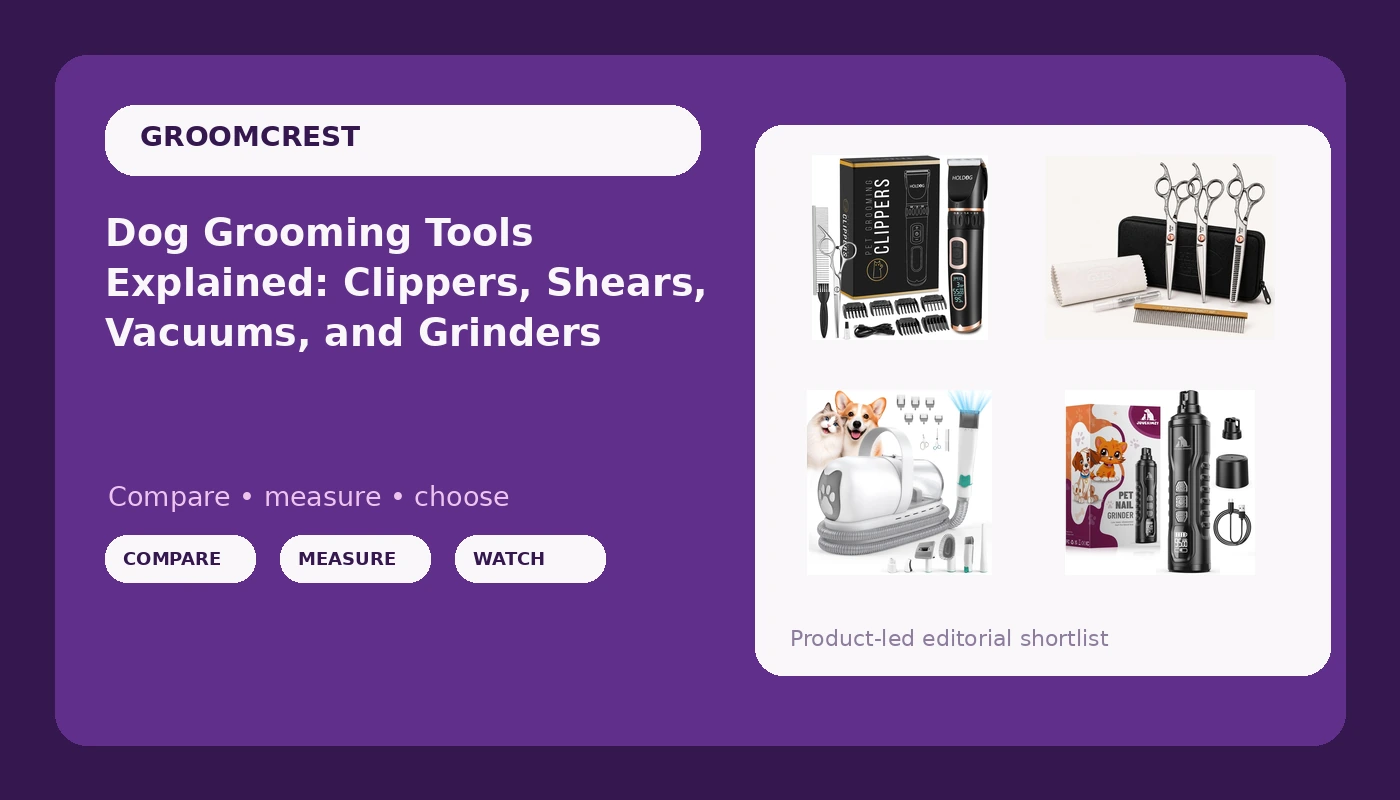
Most people shopping for dog grooming tools at home start with the wrong question. They ask which clipper is the best, buy one, and then discover the hard part was never the clipper. It was the mat behind the ear, the nail they were afraid to cut, and the undercoat that keeps landing on the couch. Grooming is really four jobs stacked on top of each other: cutting coat, scissoring the places a blade cannot reach cleanly, collecting loose hair and undercoat, and shortening nails. Each job has its own tool, and each tool has a limit that no sticker on the box mentions. This explainer walks through four at-home dog grooming tools worth considering, what each one is genuinely for, and how to tell whether your dog needs it at all.
Related: How to Brush a Doodle Coat Without Matting It →
Quick answer
Buy the tool that matches the job your dog actually has, not the one with the longest feature list. A cordless clipper covers body coat on most breeds. A shear set covers faces, feet, and the finish work clippers cannot do cleanly. A grooming vacuum is a between-grooms maintenance tool for loose hair and light trimming, not a replacement for a bath or a full clip. A nail grinder is the gentler way to shorten nails, especially on dark nails where the quick is invisible. If you own one dog with a simple coat, two of these four will cover nearly everything. If you own a doodle or a double-coated breed, all four earn their shelf space, because that coat hands you four different problems.
Four useful options
| Model | Best fit | What stands out |
|---|---|---|
| HOLDOG Dog Clippers Professional Heavy Duty Grooming Clipper 3-Speed Low Noise High Power Rechargeable Cordless Pet Tools for Small & Large Dogs Cats Pets with Thick Coats | Body coat on most breeds, including thick coats | Rechargeable cordless body with three speed settings |
| Geib Buttercut Dog Grooming Scissors Kit, Three-Piece Set with Straight, Curved and 35-Tooth Blending Shear, Stainless Steel, Zipper Case Included | Faces, feet, topknots, and blending | Straight, curved, and 35-tooth blending shears in one case |
| 2026 Upgraded Dog Grooming Vacuum Kit with Nail Clipper & Dematting Comb, 13000Pa Pet Vacuum for Shedding, 9-in-1 Dog Hair Vacuum, 1L Dust Cup, Quiet Grooming Kit for All Dog Breeds & Cats | Loose hair, shedding control, light trims | 13,000Pa suction, 1L dust cup, nine-piece kit |
| Electric Dog Nail Grinder: Upgraded 5-Speed Quiet Dog Nail Trimmer-Safe Painless Nail File for Claw Trimming & Grooming Care at Home for Dogs & Cats | Nail shortening, especially dark nails | Five speeds for gradual removal |
The clipper: HOLDOG Dog Clippers Professional Heavy Duty Grooming Clipper
The clipper is the tool with the steepest learning curve, and the curve has nothing to do with the price. Blade heat is the number nobody prints on a box. A blade that runs warm against your wrist after a few minutes will run warmer against a dog's belly, and that is how blade burn happens. The fix is technique, not wattage: keep the blade moving, work in passes instead of parking in one spot, and let the blade cool between sections. Snap-on combs are the other thing to understand early. They ride over the blade to leave a longer coat, and on curly or dense coats a comb that does not seat properly will pop off mid-leg. If you are clipping a doodle for the first time, work in short, deliberate strokes and stop before the tool gets hot, even if the groom is only half finished.
The finish work: Geib Buttercut Dog Grooming Scissors Kit
Tooth count on a blending shear is the detail that decides how much coat it removes per pass. A 35-tooth blender is a soft tool: it takes a little hair and leaves a natural edge, which is what you want on a head or a leg. Fewer teeth means more aggressive blending and more room for a visible line. Scissors also demand one habit that clippers do not: never cut toward a fold of skin, and never cut without seeing the blade tip. Faces, paw pads, and sanitary areas are where nicks happen, and they happen almost every time because the groomer was working by feel instead of by sight. If you only ever buy one pair, make it the curved shear. It is the one that does the work people actually notice.
The shedding control: 2026 Upgraded Dog Grooming Vacuum Kit
The honest framing for any grooming vacuum is this: it collects hair while you brush, which keeps loose fur off the floor and out of the air, and it can tidy light coat with a clipper attachment. It is not a bath and it is not a substitute for a real clipper on a full groom. On a double-coated dog, suction mostly grabs the topcoat, while the undercoat that causes the shedding problem sits deeper and responds better to a blowout with moving air. Where a vacuum shines is the between-grooms window: ten minutes on the couch on a Tuesday, loose hair gone, dog calmer about being handled. Noise is the dealbreaker on this category, not suction. A vacuum that runs loud at the dog's ear will end the session faster than any attachment can save it, so let the dog hear it running in another room before you ever touch it with the tool.
The nail tool: Electric Dog Nail Grinder
The quick is the pink nerve and blood supply inside the nail, and hitting it once is a lesson a dog remembers for years. Grinding avoids the sudden cut that causes most quicks: you take a little, look at the flat end of the nail, and take a little more. On dark nails that is the whole advantage, because you can watch the center of the nail lighten as you approach the quick. Start on the lowest speed, touch the nail for a second or two at a time, and stop the moment the dog pulls the paw away. Clippers are faster on a calm dog with clear nails; a grinder is safer on a nervous dog with black nails. Most groomers keep both and choose per dog, not per trend.
Prices and availability may change. Product images, names, and retailer links are matched to verified listings. No current price, rating, stock status, or measured result is stated here without current evidence.
How coat type decides which tool you reach for
Coat type, not breed name, is what tells you which of these tools you actually need.
A double coat, meaning a topcoat plus a dense undercoat, belongs to huskies, goldens, labs, and most shepherds. These dogs shed in volume, and the undercoat is the culprit. A grooming vacuum helps with surface hair between blowouts, but the real tool for a double coat is moving air and a rake, and the bath schedule should be sparse because shampoo strips the oils that keep the undercoat healthy. Clipping a double coat short is usually a mistake: it does not stop the shedding and it can leave the coat growing back unevenly.
A single coat, meaning continuously growing hair, belongs to poodles, doodles, Yorkies, and bichons. This is the coat that needs the clipper and the shears, because the hair keeps growing and mats when it is not cut and brushed. Curly coats are the hardest version of this: the hair tangles against itself, so mats form close to the skin and a clipper can stall in them. That is why doodle owners end up needing the full set, clipper for the body, shears for the face and feet, grinder for the nails.
Short, smooth coats are the easy case. A rubber curry or a slicker does most of the work, a vacuum handles the shedding, and a grinder handles the nails. You can groom a lab at home for years with two tools and a bathtub.
What the numbers on the box do not tell you
Runtime claims are usually measured in ideal conditions, not in a real coat. A battery rating tells you how long the motor runs, not how many dogs it finishes. A noise figure printed on a box is often measured from a distance, while your dog is hearing the tool inches from its head. Suction ratings do not account for a clogged filter or a dense undercoat. None of these numbers are lies, exactly, they are just measured somewhere other than your living room.
- Identify the job. Body coat, face and feet, loose hair, or nails. Buy for the job you have, not the job the ad shows.
- Match the tool to the coat. Double coat means air and a rake. Curly single coat means a clipper plus shears. Short coat means a brush and a grinder.
- Start with the least intimidating tool. Let the dog meet a quiet, switched-off tool before it ever touches hair. A dog that sniffs the grinder first is a dog that tolerates it later.
- Check the blade and the bit before every session. A dull blade drags and pulls, and a clogged filter kills suction. Maintenance is most of the difference between a tool that works and a tool that disappoints.
- Know when to stop. Half a groom finished calmly beats a full groom finished with a stressed dog. You can always finish tomorrow.
Before you buy anything
- Measure the dog, not the ambition. A 70-pound dog that leans needs stability in every tool you put near it, and a 6-pound Yorkie needs small heads and light handles.
- Decide who is doing the work. If a groomer still handles the body clip, your home kit only needs the maintenance pieces.
- Budget for consumables. Blades dull, filters clog, and grinding bits wear down. The tool is the cheap part over five years.
- Consider noise before power. A more powerful tool the dog will not tolerate is worth less than a modest one the dog accepts.
- Keep a matted dog out of the equation. Mats are not a home-grooming project. They are a shave-down and a conversation about brushing.
Which option should you choose?
Choose the HOLDOG Dog Clippers Professional Heavy Duty Grooming Clipper when you need to cut body coat at home and want one cordless tool with more than a single speed. Choose the Geib Buttercut Dog Grooming Scissors Kit when your dog has a face, feet, or topknot that needs scissor work and you want the straight, curved, and blending shapes in one case. Choose the 2026 Upgraded Dog Grooming Vacuum Kit when shedding is the daily problem and you want loose hair collected while you brush, with a nail clipper and dematting comb included. Choose the Electric Dog Nail Grinder when nails are the part you dread, especially on dark nails where you cannot see the quick.
These are roles, not rankings. A tool that suits one coat can be the wrong purchase for another, and none of the four replaces a bath, a brush-out schedule, or a vet visit for skin and ear problems. Coat condition, temperament, and how often you actually groom will decide more than any spec sheet.
The bottom line
Grooming tools fail at home for predictable reasons: the wrong tool for the coat, a blade that got hot, a nail cut too close, or a vacuum loud enough to end the session. Fix the tool choice and most of those problems disappear. Match the clipper to body coat, the shears to faces and feet, the vacuum to between-groom shedding, and the grinder to nails, and you can handle the routine maintenance on most dogs at home. Buy one piece at a time, learn it on a calm day, and let the dog tell you when a tool is too much. That feedback is worth more than any feature list.