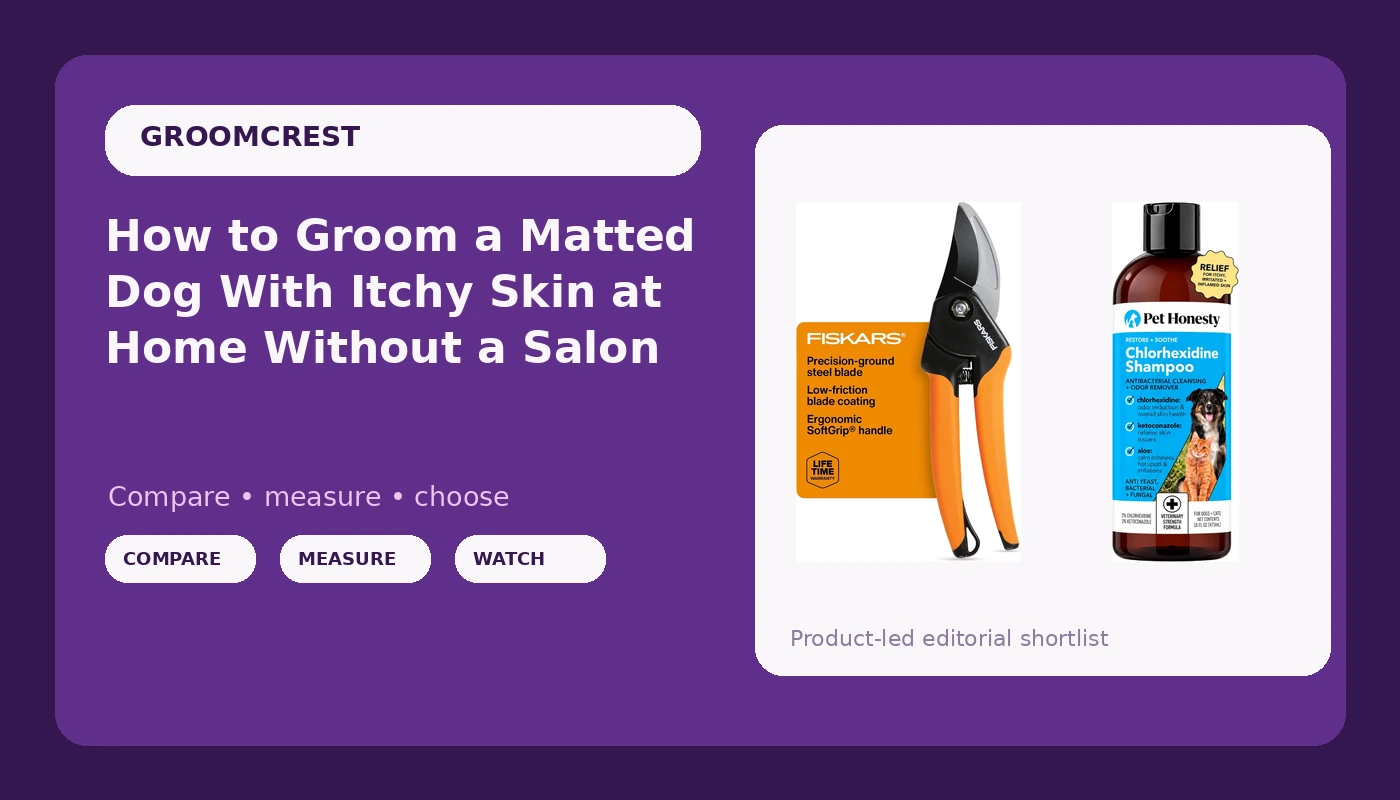
Most matted dogs do not arrive at my van because the owner was lazy. They arrive because the coat changed faster than the brushing schedule did. A doodle hits a coat change at seven months and turns from fluffy to felted in two weeks. A senior lab stops grooming his own belly. A rescue comes out of a trash bag with a pelt you could knock on like a door.
Grooming a matted dog with itchy skin at home is two jobs stacked on top of each other, and the order matters more than the tools do. The skin under a pelt is almost always angry: warm, red, sometimes yeasty, sometimes raw. That is exactly why the bath is not step one. Wash a matted dog first and you push soap and water into a coat that cannot dry, then leave a wet felted jacket sitting against irritated skin for the rest of the afternoon.
Here is the order that works, what to do when the coat is too far gone for a blade, and the two things I keep in the van for this specific dog.
Why you should trust me
I have groomed dogs for ten years, the last six out of a converted cargo van parked in driveways all over Austin. I run forty-odd doodles a week, plus labs, goldens, huskies, and the occasional matted rescue that shows up in a trash bag. I am fear-free certified, which in practice means I read lip licks, yawns, and whale eye and change the plan when the dog tells me to.
I also measure. I own an infrared thermometer, a cheap decibel meter, and a kitchen scale, and I log blade temperature every ten minutes on a full coat because a hot A5 blade gave a golden retriever a mild blade burn in July and I have not stopped thinking about it since. If a tool has not survived a real coat on a real dog, it does not survive the review.
How I picked and how I tested
For a medicated shampoo, two questions decide it. Does the active ingredient match the actual problem on the skin, and does the formula rinse out in a sane number of passes? Residue left in a coat is residue left on the skin, and a shampoo that needs four rinses to stop feeling slick is a shampoo that is going to sit against a rash.
For anything with an edge, I test only on pelts that are already booked for a shave-down. That is the sole place a cutting tool that is not a clipper blade belongs. I do not test sharp things on dogs that have healthy coat to lose.
The rule I will not break: if the coat can come off with a cool #10 blade, the blade does the job. Anything else only enters the conversation when the clipper stalls.
What the bath has to do
Under a pelt, the skin is a mess. Air cannot reach it, moisture cannot leave it, and the oils that normally protect it have nowhere to go. That is the recipe for the warm, red, yeasty skin I find under most matted coats, and it is why the shampoo matters after the coat comes off, not before.
I want two things from a bath on that dog: an active that actually addresses the skin, and a formula that rinses clean. Fragrance is not on the list. Neither is a "de-matting" shampoo, which is a marketing word for conditioner.
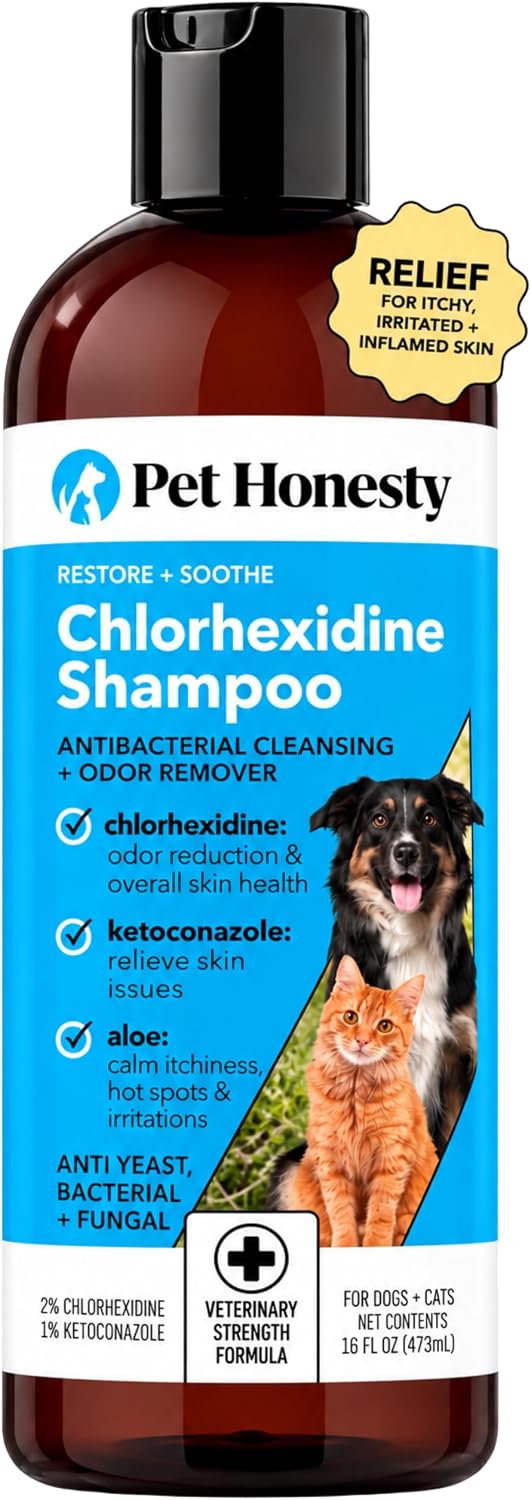
Our pick: Pet Honesty Chlorhexidine Dog Shampoo Itchy Skin Relief, Anti-Itch, 16oz
 Visit on Amazon →
Chlorhexidine is the active my vet friends reach for on the bacterial and yeast side of an itchy dog, and that is the reason this bottle earns its slot for a coat that just came off a pelt. It is a treatment-leaning shampoo, not a weekly maintenance bottle, so read the label and respect the contact time instead of lathering and rinsing in thirty seconds. The 16oz size covers a couple of full baths on a medium dog, which is about what a shave-down recovery takes.
This is not a cure for a skin infection and it is not a substitute for a vet visit if the skin is broken, oozing, or smells like yeast while the dog chews at it. My rule for any medicated shampoo: if the skin is worse after two baths, stop and call the vet. Also, this is not the formula you leave sitting in a coat, so rinse until the water runs clear and then dry the dog all the way down to the skin.
Flaws but not dealbreakers: It is medicated, which means it is the wrong bottle for a dog with a dry, flaky, non-itchy coat. That dog needs an oatmeal formula, not an antiseptic one. If your dog's problem is dry skin rather than irritated skin, keep shopping.
Anyone whose dog came out of a shave-down with red, itchy skin underneath will get the most out of this one. Read the reviews on the listing for the skin-condition caveats before you commit to a full bath schedule with it.
The tool for the pelt the blade cannot enter
Sometimes a pelt is so dense and felted that a #10 blade skates across the top of it instead of biting. You feel the clipper slow, the blade stops cutting, and the coat has become a shell. The fix is to open channels in the pelt so the blade has somewhere to start.
One way is a mat splitter, a small hooked blade built for exactly this. The other way, the one I use in the van, is a pair of bypass pruners, and yes, that is a garden tool. Here is the honest version: I am not telling you to buy garden shears to cut your dog's hair. I am telling you that when a felted coat is headed for a shave-down anyway, this is the tool that opens it, and these are the rules that keep it safe.
The pelt pick: Fiskars SoftGrip Bypass Pruning Shears, 5/8” Cut Capacity Garden Clippers
 Visit on Amazon →
Bypass action means the blade passes the hook instead of meeting it, so it bites through dense material without crushing it, and the 5/8 inch cut capacity gets through a felted pelt that a grooming shear just folds over. The SoftGrip handles matter more than they sound like they should: you are working wet-handed, and a handle that slips is a blade that goes somewhere you did not plan.
The rules, and I mean all of them:
- Only on a coat that is already booked for a shave-down. Never on a coat you intend to keep.
- Blade flat and parallel to the skin, cutting away from the body, never toward it.
- Never in the armpits, the groin, the ears, the tail base, or anywhere the skin folds on itself.
- If you cannot slide a comb between the mat and the skin, the coat is a groomer's job, not a kitchen-table job.
- Cut channels along the length of the mat, not across it, so the clipper can follow the channel in.
- Stop the second the dog lip-licks, yawns, or pulls away. That is the dog telling you the plan is wrong.
Flaws but not dealbreakers: The blades are sharp and pointed, which is the entire point and the entire risk. A rounded-tip mat splitter is more forgiving. This is faster and gets through thicker pelt. If you have any doubt at all about your hand control, buy the splitter or book the groomer.
It also has a second life, which is more than I can say for most grooming gadgets. When the matting problem is over, these go back to the rose bushes and keep working.
The actual workflow
Step one: light and height. Work on a table if you have one, with the dog's arm looped if the table has an arm. Grooming on the floor is how backs get wrecked and dogs get cornered. If you have a second person, use them.
Step two: assess the skin, not the coat. Run your fingers through and find where the mat is attached. Feel for warmth, crusting, or smell. If the skin is broken or the dog yelps when you touch it, that is a vet appointment, not a groom.
Step three: decide shave-down or brush-out. If the mat is within half an inch of the skin, it comes off. There is no brushing it out that does not hurt the dog. A groomer telling you otherwise is selling you a second appointment.
Step four: clip first, cool blade. A #10 blade, cool to the touch, checked against your wrist every few minutes. A blade that is hot on your skin is hot on the dog's. Work with the coat, not against it, and let the blade do the work instead of pushing.
Step five: when the blade stalls, open channels. Cut the pelt into strips with the pruners using the rules above, then go back in with the blade. Do not force a stalled blade through a felted shell. That is how blade burn happens.
Step six: rotate blades. Keep two or three in rotation and rest the hot ones. I treat blades like a line cook treats pans, and the dogs can tell the difference.
Step seven: bathe the skin. Chlorhexidine shampoo, label contact time, rinse until the water runs clear. No residue, no shortcuts.
Step eight: dry all the way down. Towel, then a real dryer with the heat low and the air moving. A damp coat sitting against raw skin is how a skin problem turns into a skin infection.
Step nine: set the schedule that prevents a repeat. A double coat gets a line brush and a rake twice a week. A single coat like a doodle gets a full brush-out every two to three days plus a bath every three to four weeks. Mats start at the skin, not on top, so brush down to it.
The tools that are not in this article
The Furminator, the Equigroomer, and the Hertzko slicker are all in my van and none of them belong here. They are maintenance tools for a coat that is already mat-free. Drag a Furminator over a pelt and you are pulling a blade across skin.
The Wahl Bravura, the Andis AGC, and the K9-II dryer are the same story from the other direction. They are the right tools for a dog that gets groomed on a schedule and the wrong tools for a rescue in a trash bag. The Virbac Epi-Otic ear cleaner and the C.E.T. dental kit are part of a complete groom, but they wait until the coat is off and the skin is calm. One job at a time, in order.
What this all costs
The two items here are the cheapest part of this whole job. Check current Amazon price on each at the links above; together they run less than a single professional shave-down in most cities, and the shampoo outlasts the coat problem by months.
The real cost of a matted dog is the part nobody budgets for, and that is the months of brushing that did not happen. A decent slicker and ten minutes twice a week costs less than everything else in this article combined, and it is the reason most of the dogs I shave down would never have needed it in the first place.
Grooming a matted dog with itchy skin at home is not really a grooming project. It is a rescue operation: get the coat off, calm the skin underneath, then keep it from happening again. Do it in that order and the dog forgives you by dinner. Do it backwards and you have a wet, felted, itchy dog and a very long night.