Most owners think at-home dog and cat grooming means baths and bows. It means two jobs: nails and coat. Get those two right and the bath gets easy, the shedding becomes manageable, and your groomer stops giving you the look at drop-off. Skip them and no shampoo on earth will save the coat.
I have groomed dogs for ten years, the last six out of a converted cargo van I park in driveways all over Austin. I run forty-odd doodles a week, plus labs, goldens, huskies, and the occasional matted rescue that arrives in a trash bag. The dogs that show up with a pelt and eight curved claws are almost never neglected. They are loved, well fed, and sleep on the bed. Their owners simply never built a routine for nails and coat.
So here is the routine, built around the two tools that do the most work for the least drama: a plier-style nail trimmer for the dog, and a fine-pin shedding brush for the cat. If you can trim nails and get a brush through the coat, you can keep both animals comfortable between professional grooms.
Why you should trust me
I started at 19 as a bather in a strip-mall salon. On my third week the only groomer quit mid-shih-tzu, the dog was half pelted, the owner was already in the lobby, and I finished it with a 10 blade, a lot of patience, and a bruised thumb. I have been finishing other people's dogs ever since.
The van changed how I judge gear. There are no salon walls to absorb noise, my inverter limits which dryers I can run, and the dog sits six inches from the motor instead of across the room. So I measure. After a hot blade gave a golden retriever a mild blade burn one July, I bought an infrared thermometer and logged blade temperatures for a month. The job book in the van holds decibel readings, runtimes timed on my phone, grams of undercoat weighed on a kitchen scale, and a count of how many dogs each tool survived before it quit on me. I am fear-free certified, which in practice means I watch for lip licks and yawns and change the plan when the dog tells me the tool is too much.
What follows is how I would set up a first-time owner, and the two tools I would hand over first.
The two jobs, and how often they need doing
Nails first, because nails are the job people skip. Most dogs need a trim every three to four weeks. If you can hear the nails clicking on a hard floor, you are already late. Long nails push the toe out of alignment and change how the dog stands, and the quick grows down into the nail, so every trim gets harder the longer you wait. Dewclaws are part of the job, and they are the ones that curl into the leg when they are ignored.
Coat second. Every dog is a double coat or a single coat, and the answer is different for each. A double coat (husky, golden, lab) is a topcoat plus a dense undercoat. Those dogs get a line brush and a rake twice a week, and a blowout when the seasons change. Bathing them more often does not reduce shedding. It strips the oils that keep the undercoat healthy and makes the shedding worse.
A single coat (poodle, doodle, Yorkie, bichon) grows continuously, so it mats instead of shedding. Those coats need a full brush-out every two to three days, with extra attention to the collar area, the armpits, and behind the ears, which are the three places mats start.
Cats are their own schedule. A short-haired cat gets brushed once or twice a week. A long-haired cat gets it every other day, and the spots that matter are behind the ears, the belly, and the base of the tail, because those are the spots cats groom most and mat first.
The gear I would start you with
You need two tools for these two jobs. You do not need a grooming table, a high-velocity dryer, or a kit with eleven attachments to start. You need a trimmer that cuts cleanly and a brush the animal will tolerate.
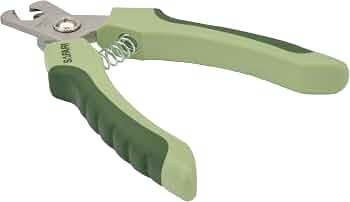
Our pick for nail trims: Coastal Pet Safari Professional Dog Nail Trimmer
 Visit on Amazon →
Check current Amazon price. This is a plier-style trimmer in the standard 5 by 1.5 inch size, listed for small and large dogs, which is the right way to shop for a first trimmer. Plier style matters more than people think. Scissor-style trimmers squeeze the nail as they cut, and on a thick nail that squeeze is what makes a dog pull its paw back. A plier cuts with a straight one-handed motion, so you can hold the paw steady with the other hand and take small slices instead of one big guess.
The honest caveat: on a big dog with thick nails, a standard trimmer is work. If you are squeezing with both hands and the nail is fighting you, that is your signal to move up to a heavier trimmer or a grinder, not to push harder. Dull blades are the other failure point. A dull trimmer crushes the nail instead of cutting it, the nail flakes, and the dog remembers. If it starts leaving ragged edges, the blade is done. Check current Amazon price and budget for a replacement before you decide the tool is the problem.
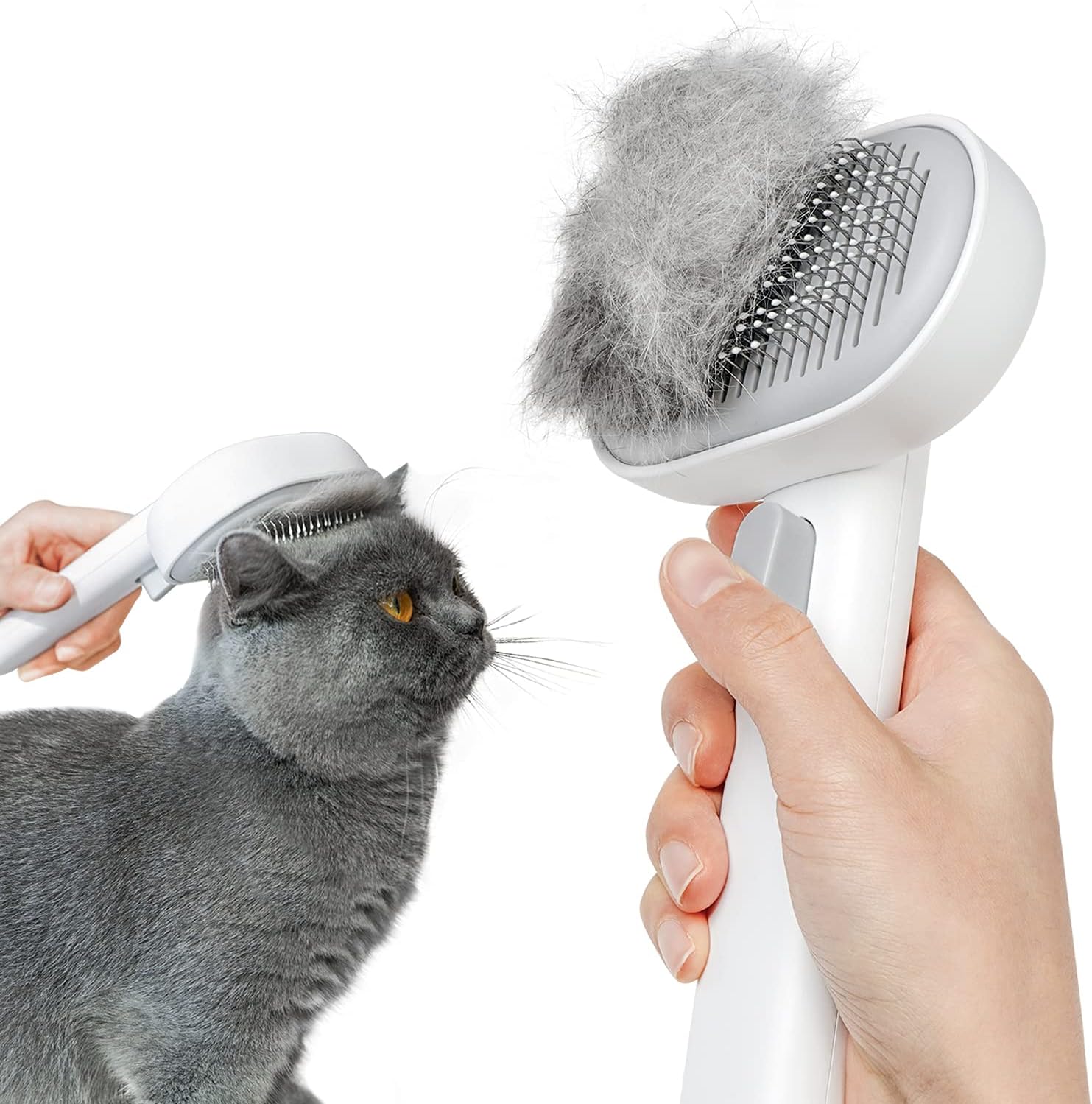
Our pick for brushing cats: Aumuca Cat Brush for Shedding
 Visit on Amazon →
Check current Amazon price. This is a shedding brush with fine pins, listed for long-haired and short-haired cats and for kittens, and that last detail is the one that matters most to me. Cats have thin, loose skin, and the tools that scratch them are the ones with stiff, widely spaced teeth. A brush described as gentle enough for a kitten is the right starting point for an adult cat that has never been brushed, and it doubles as a massage, which is how you get a cat to accept the whole idea in the first place.
The caveat: this is a loose-fur brush, not a de-matting tool. It lifts the shedding coat off a short-haired cat and helps a long-haired cat stay ahead of tangles, but it will not cut through a mat. If your cat has a solid mat behind an ear, on the belly, or at the base of the tail, put the brush down and call a groomer or your vet. Mats in those spots are a skin problem waiting to happen, and scissors near a cat's skin are how cats end up at the emergency clinic.
How to trim a dog's nails without hitting the quick
Set up before you touch the dog. Good light, a non-slip surface, treats within reach, and the trimmer in your dominant hand. If your dog is skidding on a hard floor, you are fighting the floor as well as the dog.
Handle the paws first. Press each pad so the nail extends and touch every nail with the trimmer closed. Treat. If your dog has ever had a bad trim, do this for a week before you cut anything.
Find the quick. On white nails it is the pink core you can see. On black nails, look at the cut end: a chalky grey ring near the tip means you are still in dead nail, and a solid, slightly damp-looking core means stop.
Take small bites. Hold the trimmer at roughly 45 degrees, parallel to the pad, and take thin slices. Check the cut end after every slice. Two or three small cuts per nail is normal.
Never take the whole curve in one bite. Tip and sides, then check.
Do the dewclaws. They sit up the inside of the leg, they never touch the ground, and they are the nails most likely to grow into the skin.
If you hit the quick, stay calm. Styptic powder or cornstarch, firm pressure for a minute, and end the session there. One quick is a bad day, not a ruined dog, but pushing on afterward turns a bad day into a fear of the trimmer.
Stop while the dog is still winning. One paw for a nervous dog, two for a calm one. The goal is a dog that stands still next month, not a full set today.
Repeat every three to four weeks. Consistency is what keeps the quick short and the trims easy.
Watch the dog, not just the nail. Lip licks, yawning, and the whites of the eyes showing are stress signals, and a paw pulled away before you cut is the dog asking you to slow down. The trimmer is the easy part. Reading the dog is the skill.
How to brush a cat that hates being brushed
Pick your moment. After a meal, when the cat is already sleepy and warm. Never when the cat is wound up and hunting.
Start with the face. Cheeks, chin, and the top of the head. Those are the spots cats rub on everything, so they accept touch there first.
Work with the grain in short strokes. Two minutes for the first session, then put the brush away, even if the cat is still happy.
Do the body in sections: shoulders, sides, back. Leave the belly, the back legs, and the base of the tail alone at first. Those are the overstimulation zones, and one tail flick there can end the whole project.
Go in layers on a long-haired cat. Part the coat with one hand, brush the layer underneath, then let it fall back. Skimming the top only is how mats form underneath where you cannot see them.
End before the cat ends it. A tail flick, a ripple across the skin, or flattened ears means you are done. Two good minutes beats ten minutes and a cat that hides when you pick up the brush.
Deal with the loose fur. Brush outside or over a hard floor, because a shedding brush lifts more fur than you expect and it all ends up somewhere.
Where home grooming goes wrong
Skipping nails because the dog hates it. The quick grows, the trims get harder, and the toes start to splay. The dog does not get used to it by avoiding it.
Brushing the topcoat only. Mats form underneath, against the skin, and you find them when they are already tight.
Using a bladed deshedding rake as a daily habit. It is a tool, not a lifestyle. Oversweeping cuts live topcoat, and the coat comes back coarser.
Cutting mats out with scissors. Scissors plus loose skin equals a vet bill. Mats get shaved down or worked out by a professional, and that is the honest answer.
Cotton swabs in ears. The canal is L-shaped, and a swab packs wax deeper. Clean the visible ear only, and let a cleaner do the rest.
Grooming on a bare floor. Non-slip is not a luxury. It is the difference between a dog that stands and a dog that scrambles.
Doing everything in one marathon. Nails, brush, bath, ears, and teeth in one sitting is how a dog learns that grooming is a trap.
What this all costs
Both tools sit at the inexpensive end of the grooming aisle, and I am not going to quote numbers that move. Check current Amazon price for the trimmer and the brush and you will see what I mean. What costs money is the alternative. A coat that mats into a pelt is a shave-down, and a shave-down is a full groom plus a conversation about brushing. A nail that grows into the pad is a vet visit.
The real budget item is time. Five minutes of nail work every three weeks. Five minutes of brushing three or four times a week for a double coat, a few minutes a day for a long-haired cat. That is the whole program, and it is cheaper than anything on this page.
Your dog's nails and your cat's coat are the two things you can absolutely handle at home. Set up on a non-slip surface, keep the sessions short, stop before the animal asks you to, and do it again in three weeks. The tools are the easy part.