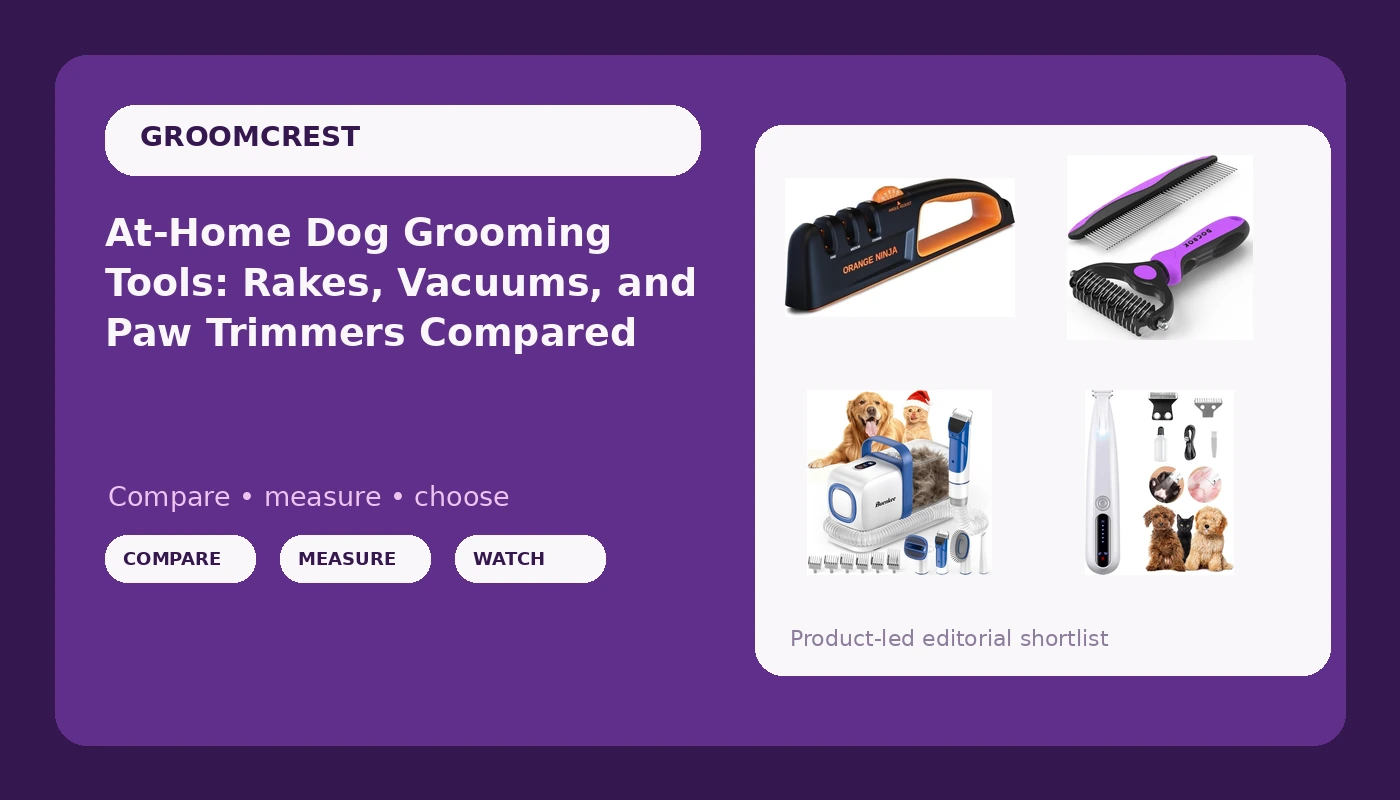
Grooming a dog at home goes wrong in predictable ways. The brush glides over the topcoat while the undercoat packs down underneath it, the clipper pulls instead of cutting, and the dog starts lip-licking halfway through a paw trim. Most of the time that is not a training failure. It is a tool-matching failure. The best at-home dog grooming tools are the ones that fit your dog's coat type and noise tolerance, not the ones with the loudest claims on the box.
This guide covers four options that between them handle the most common home jobs: lifting loose undercoat, capturing shed hair before it lands on the couch, trimming paws and faces, and one item that does not belong to the pet aisle at all. That last one is labeled honestly rather than dressed up.
Related: How to Deshed a Double-Coated Dog Without Damaging the Topcoat →
Quick answer
Match the tool to the coat and to one specific job. A rake-and-comb combo is the right starting point for long, mat-prone coats that need undercoat lifted. A grooming vacuum kit is the right starting point for shedding pickup and light touch-up clipping on short and medium coats. A compact precision trimmer is the right tool for paws, faces, and sanitary areas where a full-size clipper is simply too big to steer. Buy for the job you have this month, not the kit you imagine you will need next year.
Four useful options
| Model | Best fit | What stands out |
|---|---|---|
| Buenkee Dog Grooming Vacuum Kit | Shedding pickup and light touch-up clipping | 15,000Pa suction unit with a clipper attachment, shedding brush, and 2L collection cup |
| Docrok Pet Grooming Brush and Metal Comb Combo | Long, matted, mat-prone coats | Undercoat rake for dematting and deshedding, paired with a metal comb for checking |
| 2026 New Pet Precision Trimmer | Paws, face, and sanitary detail work | LED light on a compact head, described by the listing as ultra quiet |
| 5 Precision Adjust Knife Sharpener | Kitchen knives, not pets | Three sharpening stages with five adjustable precision settings |
The all-in-one: Buenkee Dog Grooming Vacuum Kit
The appeal here is containment. Brushing a shedding dog in a living room usually means the hair you just loosened ends up on the rug, the sofa, and your clothes. A vacuum kit pulls that loose hair into a cup while you work, which is the entire reason these units exist.
Two honest limits apply. First, a grooming vacuum is a maintenance tool, not a substitute for a bath or a full-size clipper. The clipper attachment is for light trimming and touch-ups, and it is not built to run through a dense, curly doodle coat in one pass. Second, noise decides whether a vacuum kit works in your house at all. Suction numbers sell units; the sound at the dog's ear is what determines whether your dog stands still or starts shaking. Introduce it switched off, then running in another room, then near the dog, before you ever touch coat with it.
The 2L cup is a practical detail rather than a headline one. It means fewer trips to empty the bin mid-session, which matters most on heavy shedders and least on a toy breed.
The rake and comb: Docrok Pet Grooming Brush and Metal Comb Combo
The comb is the part most people ignore, and it is the part that keeps you honest. After raking a section, comb through it. If the comb passes cleanly from skin outward, that section is done. If it catches, you either need more raking in that spot or the coat has matted past the point where a rake is the right answer.
That distinction matters. Rakes lift and remove loose undercoat from coats that are shedding or lightly tangled. They are not a fix for a pelt. A coat that has packed into a solid mat against the skin will not come out with a rake no matter how patient you are, and working a rake through a pelt is how dogs get sore skin and owners get a grooming bill they did not plan for.
Use the rake in the direction the coat grows, in small sections, and stop when the rake stops finding loose hair. Daily raking on a double coat is overkill and can leave the topcoat looking thinned. Twice a week during a shed, plus a proper comb-through, is a reasonable rhythm for most long-coated dogs.
The detail trimmer: 2026 New Pet Precision Trimmer
Paws, faces, and sanitary areas are where full-size clippers become clumsy. The blade is wider than the space you are working in, the dog can see it coming, and one wrong angle nicks skin on a paw pad or a lip fold. A trimmer with a narrow head and a light built into it addresses the visibility problem directly, which is the hardest part of paw work on a dog with dark fur or thick foot hair.
Be clear about scope. This is a detail tool. It is not going to body-clip a doodle or take down a lab's coat, and expecting it to will leave you with a hot blade and an unfinished dog. On black nails, a grinder remains the safer route for most owners, because grinding removes material in small increments instead of clipping past the quick in one motion.
Noise is worth checking yourself rather than trusting the word on the box. "Quiet" on a listing is a marketing term with no standard behind it. What matters is whether your dog tolerates it at the distance you actually work at, which for paw trimming is inches, not feet.
The outlier: 5 Precision Adjust Knife Sharpener
This is not a grooming product, and it would be dishonest to pretend otherwise. It is a kitchen knife sharpener that turned up in the same batch of listings as the pet tools above.
Do not put grooming shears through it. Shear blades are ground to a different bevel than kitchen knives, and a pull-through or guided sharpener set up for chef's knives will alter that geometry. Shears that get sharpened on the wrong equipment cut worse than they did before, and a dragging shear is how faces get nicked. If your shears are dull, they go to someone who sharpens shears, or back to the maker.
So why include it? Because a buying guide that quietly swaps in a plausible-sounding product is not useful to anyone. If your kitchen knives are dull and you are already shopping, the three-stage, five-setting format is a conventional design for home sharpening. Just keep it in the kitchen.
Prices and availability may change. Product images, names, and retailer links are matched to verified listings. No current price, rating, stock status, or measured result is stated here without current evidence.
Coat type decides the tool, not the breed name
The single most useful thing you can do before buying anything is figure out which of two coats your dog has.
A double coat is a topcoat plus a dense, woolly undercoat. Huskies, golden retrievers, and Labradors are the familiar examples. The undercoat sheds in cycles and packs down against the skin, and the topcoat is the weather protection you do not want to destroy. Double coats get brushed and raked, and they get blown out with air when they are shedding heavily. They should not be shaved for summer, because the coat that grows back is often coarser and the dog loses its insulation against heat and sun. For this coat type, a rake and a comb earn their place, and a grooming vacuum is a secondary convenience rather than the main event.
A single coat is hair that keeps growing. Poodles, doodles, Yorkies, and bichons are the usual examples. There is no undercoat to lift, which is why rakes do less for these dogs than owners expect. What matters here is line brushing down to the skin, a comb to check the result, and regular trimming, because the hair that keeps growing is the hair that mats. Mats on a single-coated dog form first where there is friction: behind the ears, under the collar, in the armpits, along the belly, and at the base of the tail. Those five spots are where you should be checking with a comb every few days.
Short single coats, like a boxer or a greyhound, are the easiest category. A rubber curry or a soft brush lifts loose hair, and the shedding is over quickly.
What a grooming vacuum can and cannot do
A grooming vacuum kit is best understood as a containment system. Its job is to hold the hair you have already loosened so it does not end up on your floor. The deshedding attachments work on short and medium coats, and the clipper attachment handles light trimming and tidy-ups.
What it cannot do is reach the undercoat of a dense double coat. Suction pulls at the surface; undercoat sits close to the skin under a layer of topcoat. For a husky in blow, air does the work that suction cannot, and a high-velocity blowout before the bath lifts more loose coat than any attachment on a vacuum. If your dog is a heavy double-coated shedder, the honest order of purchases is a dryer first, a vacuum second.
Noise is the variable that decides whether the tool gets used at all. Most grooming vacuums sit in a range where nervous dogs start showing stress signals, and a tool that scares your dog is a tool that stays in the closet. Suction and capacity are easy specs to compare. Temperament is not.
- Identify the coat type first: double, single, or short single.
- Name the one job you need to solve this month, whether that is shedding, matting, or paw detail work.
- Test your dog's noise tolerance before committing, using the tool switched off, then running at a distance.
- Start with the least invasive tool that can do the job, and add only when it stops working.
- Check the result with a metal comb rather than by eye, because coats hide packed hair well.
Practical guidance for home grooming sessions
- Work at a height that saves your back and keeps the dog from being cornered. Grooming on the floor is how both of you end up frustrated.
- Brush in sections, parting the coat and working from the skin outward. Skimming the surface is how undercoat gets missed for weeks.
- Keep sessions short. Ten to fifteen minutes of calm work beats a forty-minute battle, and ending on a good note is what makes the next session easier.
- Check the five friction spots every few days: behind the ears, under the collar, the armpits, the belly, and the tail base.
- Watch the dog, not the clock. Lip licking, yawning, and the whites of the eyes showing are all signals to stop, reset, and change the plan.
- A matted coat is a shave-down and a conversation about brushing, not a longer brushing session.
Which option should you choose?
Choose the Buenkee Dog Grooming Vacuum Kit when your main problem is shed hair landing everywhere and your dog tolerates the sound of a vacuum. Choose the Docrok Pet Grooming Brush and Metal Comb Combo when you have a long, mat-prone coat that needs undercoat lifted and checked with a comb. Choose the 2026 New Pet Precision Trimmer when your recurring job is paws, face, and sanitary areas rather than full-body clipping. Choose the 5 Precision Adjust Knife Sharpener only if what you actually need is sharper kitchen knives.
None of these four replaces a bath, a dryer, or a proper blade on a full-size clipper, and none of them is a fix for a coat that has already matted to the skin. Tool specs are easy to compare in a table. How your individual dog responds to noise and handling is not, and that is the variable that decides whether any of this works in your house.
The bottom line
Home grooming succeeds or fails on three things: the right tool for the coat in front of you, a dog that is calm enough to stand for it, and a comb to verify the work. A rake and comb handle loose undercoat on long coats. A vacuum kit handles containment and light trimming. A compact trimmer handles the small, fiddly areas that full-size clippers cannot reach. Everything else is a sticker on the box, and the one kitchen tool in this batch stays in the kitchen.