Most home grooming setups fail for the same reason: the tool was chosen from the product photo instead of from the coat on the dog standing in front of you. Search for dog grooming clippers and deshedding tools and you get a wall of near-identical boxes, all promising a quiet motor and a smooth cut, with no mention of blade heat, coat density, or the fact that clipping and deshedding are two completely different jobs. A clipper shortens hair. A deshedding tool lifts the dead undercoat a clipper was never designed to reach. Buy one expecting it to do both and you finish with a half-done dog and a tool you resent. What follows is an honest look at four options, what each one is actually for, and where the trade-offs sit.
Related: How to Deshed a Double-Coated Dog Without Damaging the Topcoat →
Quick answer
Match the tool to the coat and the job, not to the box copy. A cordless clipper with adjustable speeds and a rechargeable battery is the most flexible single purchase for a dog with a thick or heavy coat. A low-noise clipper kit is the sensible entry point for a first-time home groomer working on a small or medium dog or a cat. Undercoat removal on a large, long-haired dog is a separate task that calls for a dedicated deshedding tool. Keeping cutting edges in condition is a maintenance job in its own right, and it is the step most home setups ignore until a blade starts pulling instead of cutting.
Four useful options
| Model | Best fit | What stands out |
|---|---|---|
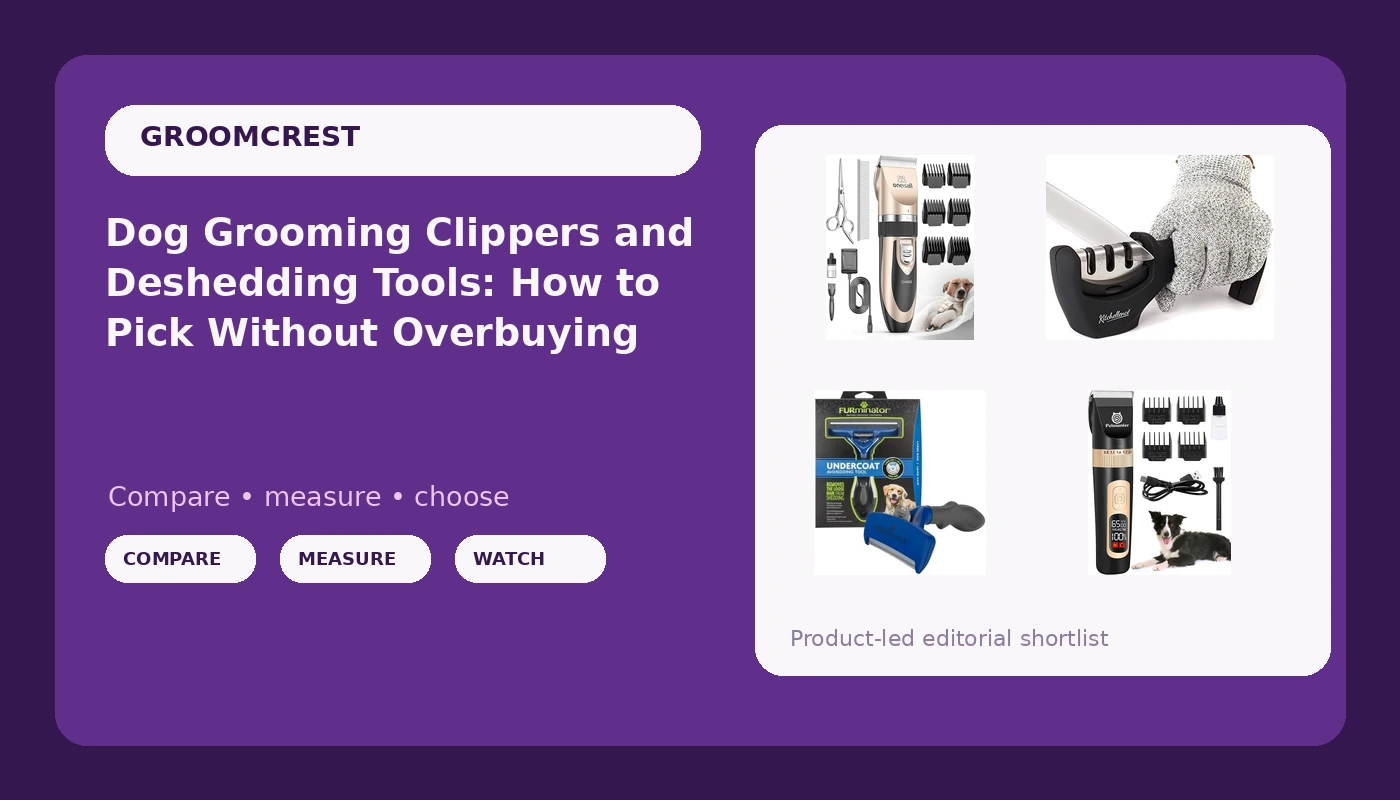
| Petsaunter Dog Clippers for Grooming, 4-Speed & LCD, Low Noise Electric Trimmer for Grooming, TypeC Rechargeable Dog Hair Clippers, Super Quiet for Dogs & Pets with Thick or Heavy Coats(C95) | A dog with a dense or heavy coat | Four speed settings, an LCD readout, and Type-C charging |
| oneisall Low Noise Dog Clippers Grooming Kit for Dogs Cats Pets | A first-time home groomer | Kit format, listed for dogs and cats, low-noise design |
| 4-in-1 Kitchen Knife Accessories: 3-Stage Knife Sharpener Helps Repair, Restore, Polish Blades and Cut-Resistant Glove (Black) | Edge maintenance and safe blade handling | Three sharpening stages plus a cut-resistant glove |
| FURminator Large Dog Undercoat deShedding Tool for Long Hair | A large, long-haired dog that sheds undercoat | Purpose-built for undercoat removal rather than daily brushing |
The cordless clipper for heavy coats: Petsaunter Dog Clippers
Two things decide whether a cordless clipper works on a heavy coat, and neither is printed on the box. The first is whether the motor holds its speed once the blade is buried in fur. A clipper that bogs and slows leaves ridges and takes three passes where one should do, and the dog feels every extra second. The second is heat. Metal gets hot with friction, a hot blade against skin is how irritation happens, and the fix is not a better clipper but a rotation: keep a second blade ready, swap when the first one warms in your hand, and let the hot one cool on a counter instead of on the dog.
Treat "low noise" and "super quiet" as relative descriptions rather than numbers. What matters practically is the character of the sound, whether it is a steady hum or a rattle, and whether the dog settles or keeps lip-licking while it runs. Run the clipper with the blade off the dog first, let the dog hear it, and only then start work.
The low-noise starter kit: oneisall Dog Clippers Grooming Kit
Know what a kit is and what it is not. A kit clipper is built for maintenance trims: faces, feet, sanitary areas, and light body work on a small or medium dog. It is not the tool for stripping down a dense doodle coat every six weeks, and kit motors are the first thing to fade when they are pushed that hard. Guard combs are the other weak point. A plastic comb that rides over the blade is convenient, but combs that fit loosely pop off mid-leg, and the blade underneath takes a bite of coat before you can stop. Check the fit of every comb before it goes near the dog, and if one is loose, do not use it.
The edge maintenance piece nobody plans for: 3-Stage Knife Sharpener and Glove
Here is the honest part. A pull-through sharpener with staged slots is designed for the bevel of a kitchen knife. Grooming shears are a different animal: good ones are convex-edged, and dragging them through a carbide slot removes the edge geometry that makes them cut. Clipper blades are different again and need a flat lapping or a specialized service. So this tool is not a replacement for professional sharpening, and it should not be sold to you as one. What it does do is keep household knives sharp, and the glove does real work on a grooming bench where you are changing blades and handling curved shears with wet hands.
The practical takeaway is the schedule, not the gadget. Blades and shears dull at a rate you can feel before you can see it: when a shear starts pushing the coat instead of slicing it, or a blade leaves a track instead of a clean line, that is your signal. Rotate spare blades so you always have a sharp one, and send shears out for professional service on a schedule rather than waiting for a bad groom to remind you.
The undercoat tool for large, long-haired dogs: FURminator deShedding Tool
An undercoat tool pulls an astonishing amount of fur in a short session, and that is the point and the risk in one. Used with long, repeated strokes over the same spot, it can take live topcoat along with the dead undercoat, and a coat with its topcoat thinned looks patchy for months. Use it on a dry, fully brushed coat, follow the direction the hair grows, work in short passes, and stop when the fur coming off the tool thins out. It is a seasonal and maintenance tool, not a daily habit.
It is also not the answer for a matted dog. Mats are felted hair, not loose undercoat, and no deshedding tool removes them. Matted coat needs a blade and an honest conversation about how the dog got that way. Trying to rake out a pelt is how dogs get hurt.
Prices and availability may change. Product images, names, and retailer links are matched to verified listings. No current price, rating, stock status, or measured result is stated here without current evidence.
Coat type decides the tool, not the breed name
The single most useful question in grooming is not what breed your dog is. It is whether the dog has a double coat or a single coat, because that answer changes every tool recommendation.
A double coat means a weather-resistant topcoat over a dense, woolly undercoat. Think shepherds, huskies, retrievers, and most of the dogs that shed year-round and then explode in spring. That undercoat is what deshedding tools and high-velocity dryers are for. Clipping a double coat does not reduce shedding, and shaving one down can interfere with how the coat grows back.
A single coat means continuously growing hair with no undercoat to blow. Poodles, doodles, bichons, and Yorkies live here. These dogs need clipping on a schedule, plus brushing every couple of days to keep the coat from felting, and the clipper is the primary tool rather than a trim accessory. The same clipper that is perfect for a poodle face can be the wrong tool entirely for a husky's undercoat, and no amount of speed settings changes that.
Two more variables are worth naming. Heat builds in any blade that is cutting, and the answer is rotation, not a longer break. And noise is not a preference, it is information: a dog that yawns, lip-licks, or shows the whites of its eyes while the clipper runs is telling you the tool is too much right now. Slow down, switch to a quieter tool, or stop for the day. The groom will still be there tomorrow.
A five-step order for buying
- Identify the coat type on your dog before you look at a single listing. Double coat or single coat decides more than budget does.
- Separate the jobs. Clipping, deshedding, bathing and drying, nails, ears, and teeth are six different tasks, and no single box covers all six well.
- Spend where the tool runs most often. If your dog needs a full clip every six weeks, the clipper is where the money goes. If your dog only needs sanitary trims, it is not.
- Check the boring specs. Charging standard, blade system, whether the noise is a hum or a rattle, and whether replacement blades and combs are available.
- Budget for maintenance from day one. Blades dull, shears need professional sharpening, and a kit that cannot be serviced is a kit with a shelf life.
Practical guidance
- Never clip a dirty coat. Dirt and grit dull a blade faster than hair does, and a bath before a clip is what keeps edges alive.
- Brush the coat out completely before the clipper comes out. Mats and tangles are what cause pulling, and a dog that has been yanked once will remember it.
- Turn the tool on away from the dog first, let the dog hear it, then bring it to the body. Starting a clipper against a dog's skin is how a grooming session ends early.
- Clip in short sessions with breaks. Twenty focused minutes beats an hour of both of you getting frustrated.
- Keep a second blade or comb within reach and swap when the first one warms in your hand. Cool metal is the whole game.
- Never take a deshedding tool to a matted coat. Mats come out with a blade and a plan, not with more strokes.
Which option should you choose?
Choose the Petsaunter Dog Clippers when your dog has a thick or heavy coat and you want adjustable speed and a rechargeable cordless tool as your main clipper. Choose the oneisall Low Noise Dog Clippers Grooming Kit when you are grooming a small or medium dog or a cat at home for the first time and want everything in one box. Choose the FURminator Large Dog Undercoat deShedding Tool for Long Hair when you have a large, long-haired dog with a genuine undercoat problem and you understand it is a maintenance tool, not a daily brush. Choose the 4-in-1 Kitchen Knife Accessories set when you want an inexpensive way to keep household knives sharp and to have a cut-resistant glove on hand for blade and shear handling, while still sending grooming shears out for proper service.
One caveat applies to all four. None of these tools fixes a coat that is not being brushed, and none of them replaces a veterinarian for skin, ear, or dental problems. A tool is only as good as the routine around it.
The bottom line
Buy for the coat in front of you, not for the category page. A cordless clipper with speed control covers the widest range of body work on dense coats. A low-noise kit is the honest starting point for a first-timer with a small dog or a cat. A dedicated undercoat tool is what handles shedding on a large, long-haired dog, used sparingly and correctly. And edge care, whether it is spare blades or a sharpening routine, is what keeps all of it cutting instead of pulling. Get those four things in the right order and home grooming stops being a fight.