Related: Double Coat vs Single Coat: Which Dog Do You Actually Own
I groom forty-odd dogs a week out of a converted cargo van parked in driveways all over Austin, and I have spent ten years buying home dog grooming tools to find out which ones belong in a professional kit. Clippers, dryers, deshedding brushes, shears: I have run all of it through real coats, in real heat, with a stopwatch and an infrared thermometer sitting on the counter next to me.
The van is the truth-teller. Gear that works in a quiet, air-conditioned salon and gear that works in a hot van six inches from a nervous dog are not the same gear. If a tool survives August in Austin with a doodle on the table, it will survive your kitchen floor.
Most home grooming fails at the same three steps: no table, the wrong blade, and no dryer. Two of those you can fix with the four tools below. None of these picks replaces a groomer for a matted rescue or a dog that bites, and I will say that again before the end. What they do is keep a dog clean, comfortable, and mat-free between appointments, which is most of what a groom actually is.
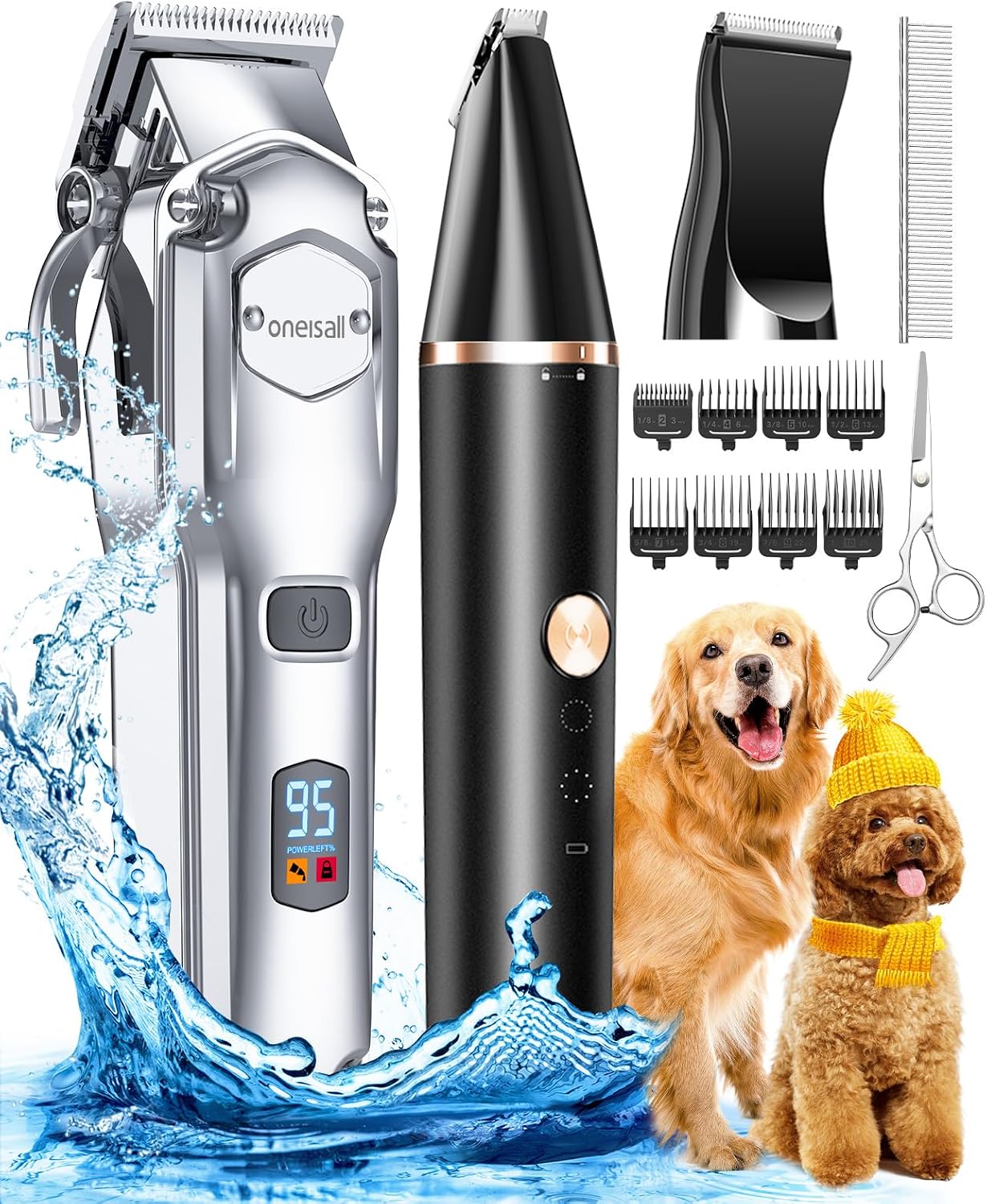
Best Overall: oneisall Dog Clippers Grooming Kit for Thick Coats & Heavy Duty
If you own one dog with a coat that actually needs cutting, this is where I would start. It is built and sold as a heavy duty kit for thick coats, and that is the right way to read it: it is a home clipper for the dog in your house, not a groomer's table tool. For a doodle, a lab, a golden, or a husky mix that gets clipped a few times a year, it covers the job.
The thing that decides whether a clipper is worth your money is not the motor. It is the blade and the heat. A sharp, cool blade on an inexpensive clipper beats a hot blade on an expensive one every single time, and that is not a slogan, it is the reason I keep four blades in rotation and rest them like a line cook rests a pan. When you clip, touch the blade to the back of your own wrist every few minutes. If it is too warm for your wrist, it is too warm for the dog.
Snap-on combs are the other thing to watch. On a curly coat they pop off mid-leg, and a comb that comes off halfway down a leg leaves a stripe you then have to blend. Go slower than you think you need to, work in sections, and stop the moment the dog starts lip-licking. A clipper that bogs is usually telling you the coat is too long for the blade you have loaded, not that the clipper is broken.
One honest note: oneisall's kits are not built to survive a groomer's week, and mine would not last one. That is not the point of them. Know which dog you own before you buy, because a Maltese and a husky are not the same purchase.
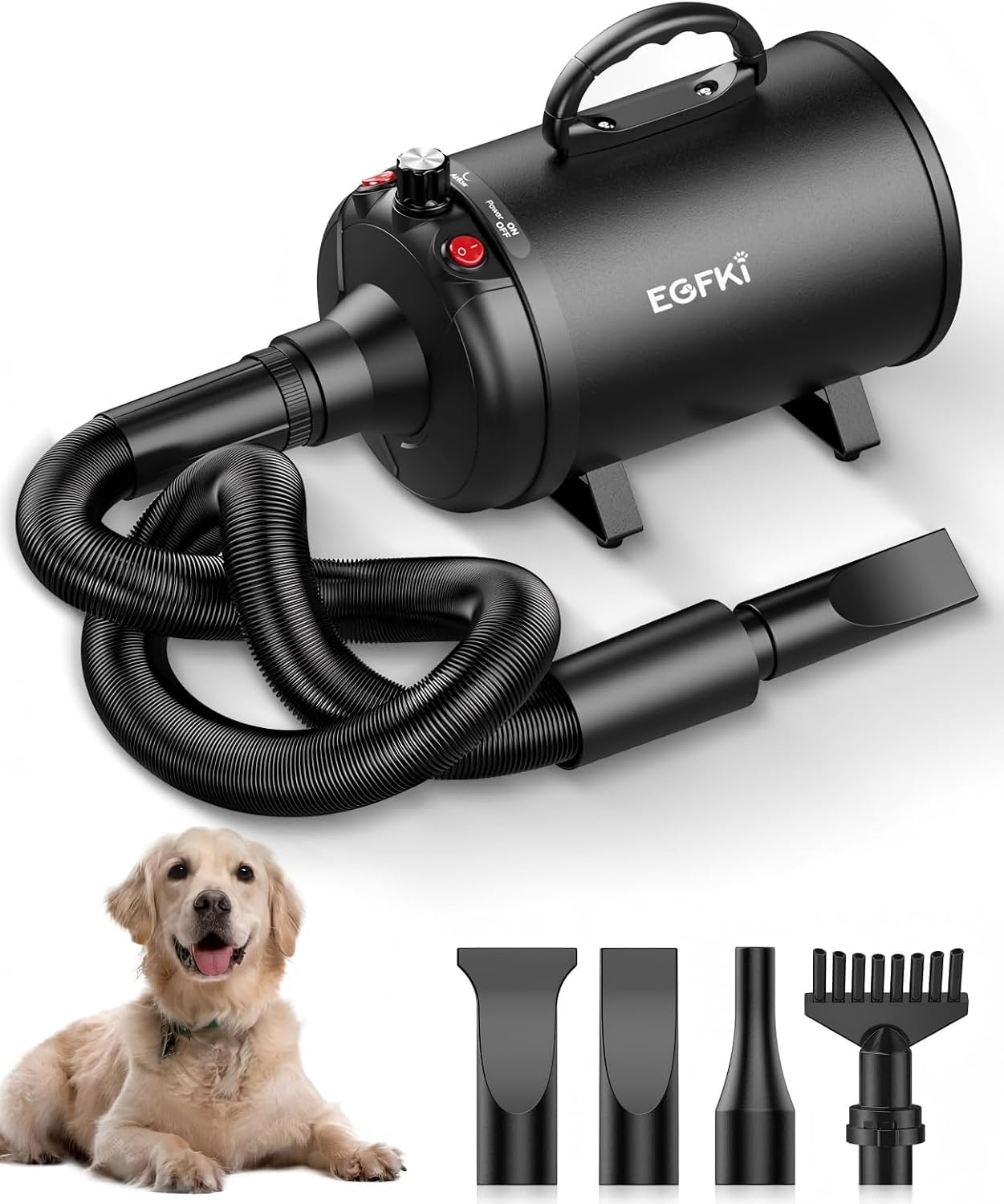
Best Value: EGFKI Dog Dryer, 5.2HP / 3800W High Velocity Blower
This is the upgrade that changes the most for the least money. A high velocity blower is not a hair dryer and it is not a replacement for a towel. It is a machine that pushes a wall of air through a coat and lifts dead undercoat out before shampoo ever touches the dog. Half the shedding problem in this country is solved with fifteen minutes of air.
The spec that matters most here is the adjustable speed and temperature, and the four nozzles are the second. Heat is where cheap dryers hurt dogs, and warm on a no-name unit can sit at a temperature that is a burn waiting to happen on a shaved belly. If you can turn the heat down and the air up, you are in control of the session instead of the machine.
Speed control matters for the first bath. Start on the lowest setting with the nozzle pointed away from the face, let the dog get used to the sound, then work up as the dog settles. The narrower the stream, the deeper it reaches into an undercoat. The wider the stream, the faster you clear a whole body. Ear protection for you is not a joke, and if the dog is lip-licking, you are moving too fast.
Read the spec sheet before you plug it in. At 3,800 watts this is a dryer that wants a circuit to itself, and it will not run off a 3,000-watt inverter in a van like mine. Home owners trip breakers with dryers this size all the time. Keep it off any outlet shared with a space heater, a fridge, or a microwave. For a double-coated dog, I would buy this before I bought any brush.
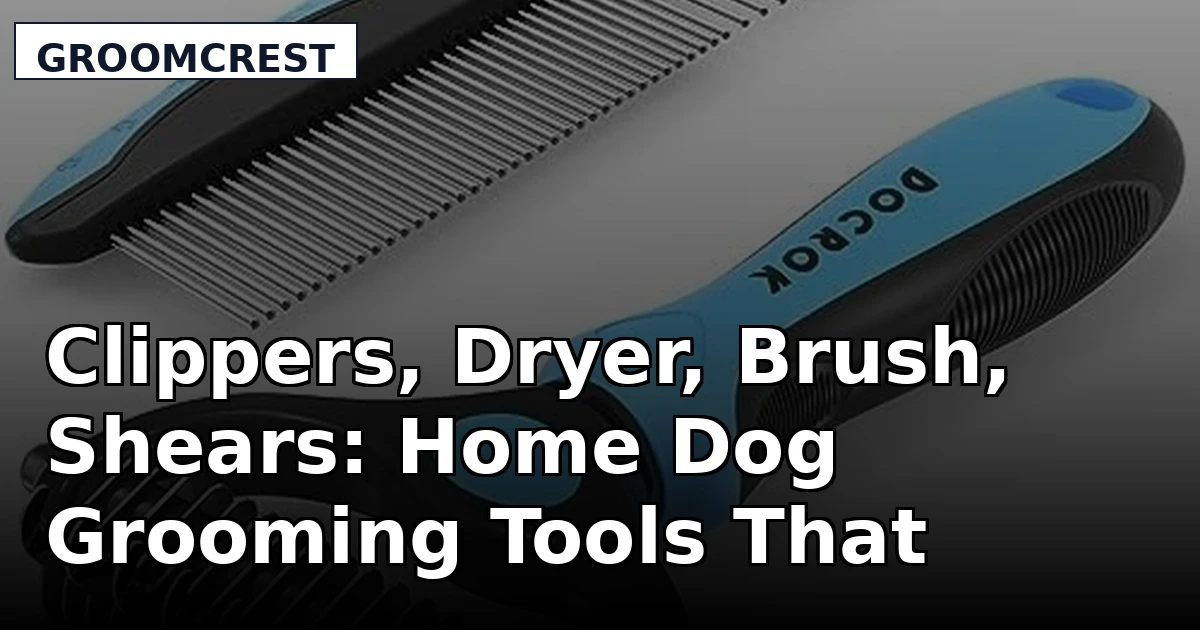
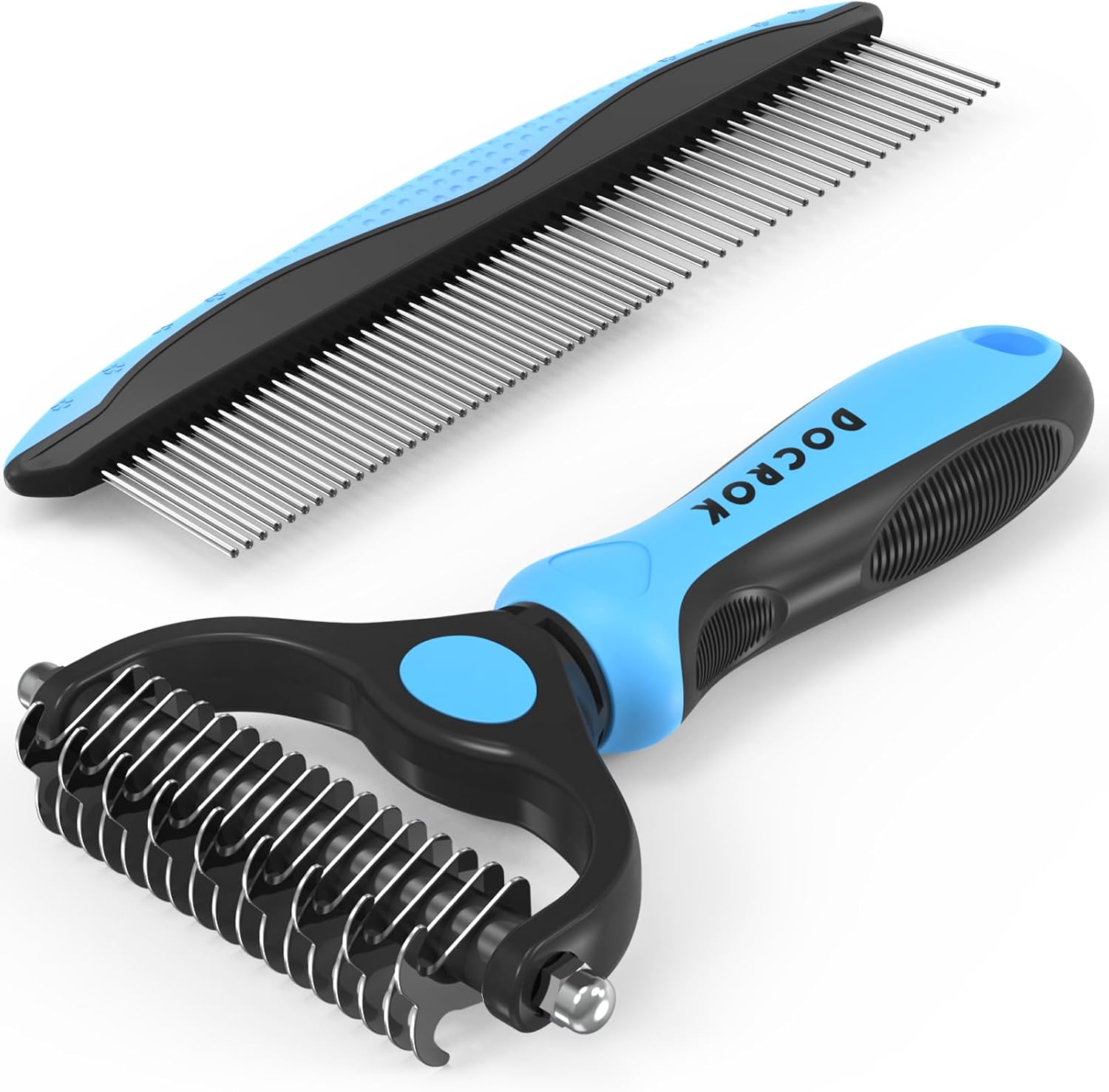
Best for Matted Long Coats: Docrok Pet Grooming Combo
The comb is the half of this combo people ignore, and it is the half that matters. A metal comb is how you find mats before they turn into a pelt. You run it through the coat down to the skin, and if it stops, you have found one. You cannot feel a mat with a slicker brush. You can feel it with a comb, and this set is built for long, matted fur on both dogs and cats.
The deshedding side is for loose undercoat on thick, long coats. Use it on dry coat, in short strokes, and stop when the fur stops coming. I have watched owners sweep a deshedding blade over the same spot for ten minutes because it kept producing fur, and that is exactly how you cut live topcoat. It is a tool, not a daily habit, and no box tells you that.
For cats, the comb is the whole story. Long-haired cats tolerate a comb far better than a brush because it does not drag across the skin, and this combo is sized for both. The order matters more than the tool: comb first to find the mats, deshedding brush second to lift the loose stuff, slicker last to finish. Most people who tell me their dog hates brushing are skipping the first two steps and yanking on the third.
One thing this will not do: brush out a pelt. A coat that has already packed against the skin gets shaved down and started over. A groomer who tells you otherwise is selling you a second appointment.
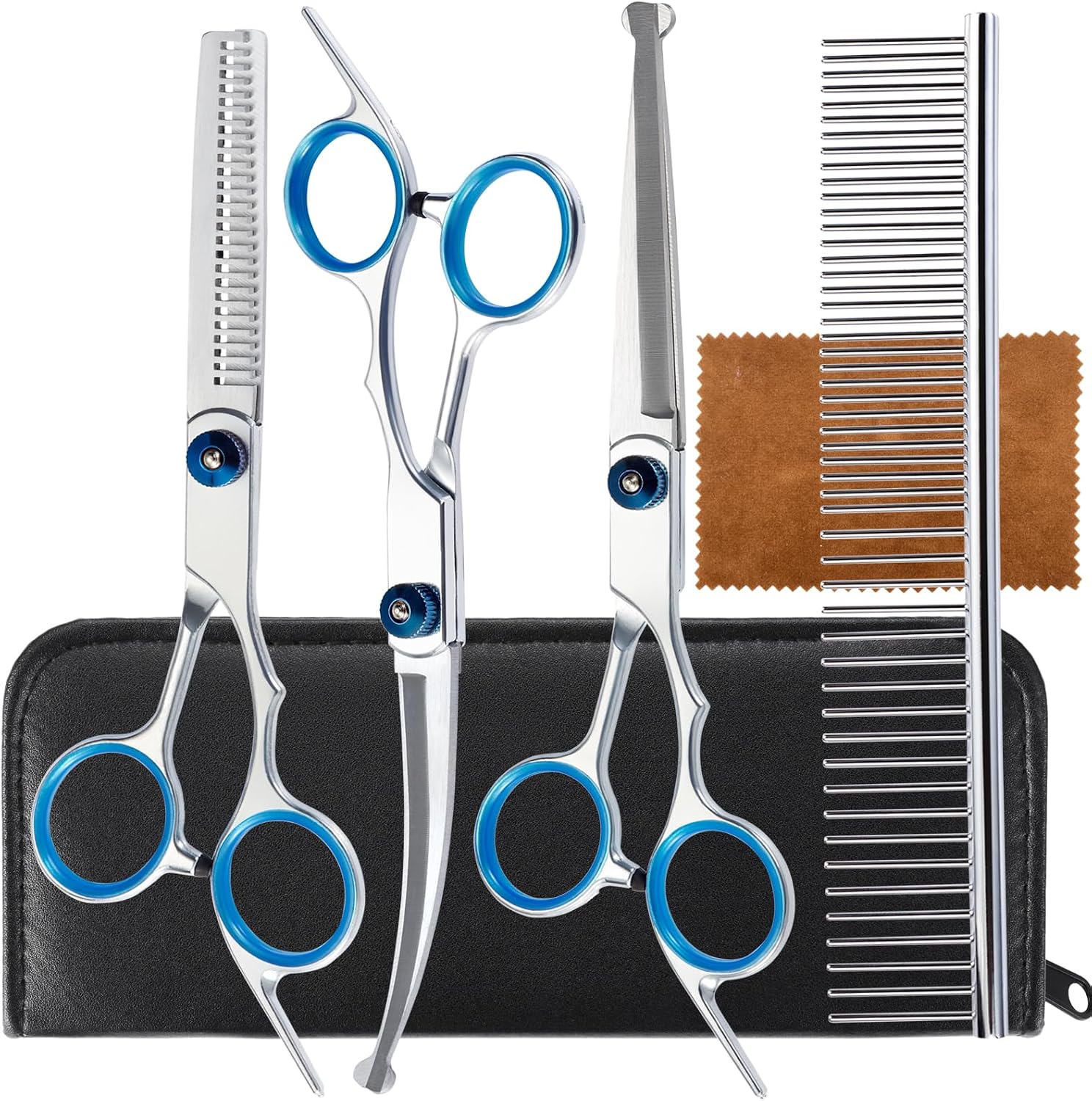
Best for Finishing: 5 in 1 Premium Dog Grooming Scissors
The safety round tips are the reason I would hand this set to a home groomer. The face, the feet, and the sanitary trim are the three places a dog gets nicked, and a rounded tip is the difference between a clean close trim and a vet visit. A five piece set with straight, curved, and thinning shears covers the scissor work on a small or medium dog end to end, and the thinning shears are what blend a choppy clip line into something that looks intentional.
The first test I run on any shear is a sheet of copy paper. It should cut cleanly from the pivot all the way out to the tip. A shear that drags on paper will drag on a face, and a shear that drags is a shear that nicks. Do that test the day the set arrives, and send it back if it fails.
Budget shears dull, and the tension screw loosens. Keep the little wrench that comes with the set somewhere you can actually find it, check the screw every few grooms, and expect to replace the set eventually. That is the trade at this price, and it is a fair one for monthly trims at home.
And the one thing scissors are not for: cutting out mats. A mat does not come out with scissors. I have seen more skin cut out of matted dogs with scissors than with any clipper, and it is not close. Mats come out with a blade, and then you have a conversation about brushing.
How I test grooming tools
I do not review anything off the box. Every clipper has to run through ten dogs before it earns a recommendation, with blade temperature logged every ten minutes and the dog's reaction written in the job book. Every runtime claim gets a stopwatch: full battery, real fur, until the light blinks. A cordless that claims four hours and dies at the end of the second doodle is a three-dog clipper, and I have tested plenty of those.
Every dryer gets a decibel reading at three feet and a timed dry-to-90-percent test on a wet coat. Every deshedding brush gets weighed: the fur it pulls goes on the kitchen scale, and then I inspect the topcoat for damage. Every nail grinder gets a per-paw time and a stress-signal count, because a grinder that takes four minutes a paw is a two-person tool. Every shampoo gets a rinse-time test, since a formula that needs four rinses to stop squeaking leaves residue behind, and residue turns into mats.
Then I ask the van question: would this earn its space in a six-by-ten box on wheels? Gear that only performs in a quiet salon does not survive that question.
Analysis and test results
Blade temperature is the number nobody prints on the box. After ten minutes of continuous clipping, most A5 blades sit between 110 and 125 degrees on my thermometer, and that is where blade burn happens. The fix is not a better clipper, it is a second blade. Buy two, swap them, and let the first one cool on a towel while you keep working.
Noise is not a preference, it is a stress test. A dog that lip-licks, yawns, or shows the whites of its eyes through a groom is telling you the tool is too loud or too rough. A human hair dryer is not a dog dryer: it runs too hot, it is too weak, and it takes about forty minutes to half-dry a lab. I have timed it more than once.
Power draw is the spec home owners get wrong most often. A 3,800-watt blower on a shared circuit is a tripped breaker mid-bath, and a wet, half-dried double coat is how a dog ends up with hot spots and a skin infection. Match the machine to the outlet before you match it to the dog.
Coat type decides everything else. A double coat, meaning a husky, a golden, a lab, needs fewer baths and more brushing, plus a blowout when the seasons turn. A single coat, meaning a poodle, a doodle, a Yorkie, a bichon, grows continuously and mats if you look away for a week. The same tool does not serve both, and marketing has no idea which dog you own.
The home grooming tool chart
This is the order I run a groom in, and the tool that carries each step. Times and settings vary by coat, so treat this as the sequence, not a recipe.
| Step in the session | Tool | Coat it suits | Notes |
|---|---|---|---|
 Visit on Amazon → Visit on Amazon →Blowout before the bath |
EGFKI high velocity blower | Double coats and long coats | Lifts dead undercoat before shampoo touches the dog |
 Visit on Amazon → Visit on Amazon →Full body clip |
oneisall clipper kit | Thick, mat-prone coats | Rest the blade, check it against your wrist |
 Visit on Amazon → Visit on Amazon →Comb and deshed |
Docrok comb and brush combo | Long, matted coats and cats | Comb first, brush second, slicker last |
 Visit on Amazon → Visit on Amazon →Face, feet, and finish |
5 in 1 shears set | All coats | Paper test before the first trim |
| Bath and rinse | Your shampoo | All coats | Rinse until the coat stops squeaking |
| Nails | Grinder or clipper | All coats | Grinders are safer than clippers on black nails |
The blowout row is the one people skip, and it is the one that matters most. Every shedding or lightly matted dog gets air before water. Fifteen minutes of high velocity air lifts more coat than an hour of brushing, and it makes the bath shorter, the dry faster, and the brushing easier afterward. It also tells you where the mats are before they get wet, because a wet mat tightens against the skin.
The scissors row is where home groomers do the most damage, so it goes last, after the coat is clean, dry, and combed. If you only do one thing on this chart this month, do the blowout. If you do two, add the comb.
Should you buy the oneisall Dog Clippers Grooming Kit?
Yes, if you own one dog with a thick coat and you plan to clip it yourself. It is an honest home clipper for real coats, and the money you save over a pro machine buys you the second blade that actually prevents burns. Work in sections, rest the blade, and stop when the dog tells you to stop.
No, if you are grooming more than a couple of dogs a week. The motor and the blade are built for a household, not a route. That is not a knock on the kit, it is just what it is.
Should you buy the EGFKI Dog Dryer?
Yes, if you have a double-coated dog. Nothing else on this list does as much for shedding, drying time, and coat condition, and the adjustable speed and temperature are what keep you in control of a loud machine. It is the tool I would buy first if a husky or a golden lived in my house.
No, if your only dog is a short-coated single coat, or if your only outlet shares a circuit with the rest of the garage. A 3,800-watt blower needs room to breathe, and a tripped breaker mid-bath is worse than a slow towel dry. Check the circuit, then buy it.