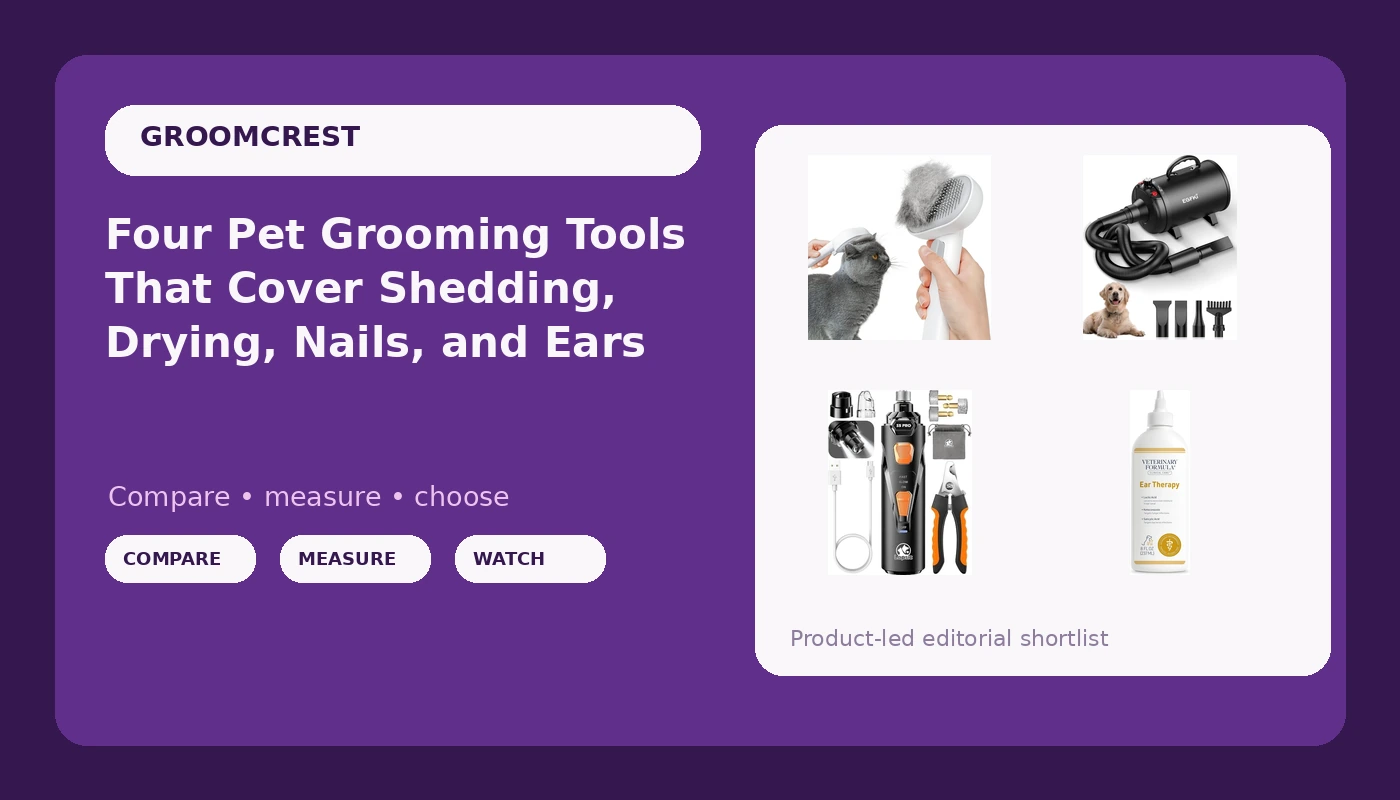
Grooming a pet at home rarely falls apart because the animal is difficult. It falls apart because the tool in your hand was built for a different job: a human hair dryer aimed at a soaked double coat, a clipper blade pushed well past the point where it should have been swapped, a brush dragged across a coat that needed air and a comb first. Putting together a small, honest kit of at-home pet grooming tools is mostly about matching four separate jobs, shedding, drying, nails, and ears, to the animal standing in front of you. The four items below cover those jobs at very different price points, and each one suits a specific kind of household rather than every household.
Related: How to Deshed a Double-Coated Dog Without Damaging the Topcoat →
Quick answer
A shedding brush handles loose coat. A high-velocity dryer handles wet coat and undercoat blowouts. A nail grinder handles nails that need rounding rather than a straight clip. An ear cleaner handles routine maintenance for ears that stay waxy or damp. If you live with one short-haired cat, the brush and the ear cleaner cover most of your routine. If you live with a double-coated dog, the dryer matters more than anything else on this page. None of these four replaces a bath, a sharp blade, or a veterinary visit.
Four useful options
| Model | Best fit | What stands out |
|---|---|---|
| Aumuca Cat Brush for Shedding | Cats, kittens, and small pets with loose fur | Listed as a grooming brush and comb for long or short haired cats, with a massage function |
| EGFKI Dog Dryer, 5.2HP / 3800W | Double coats and dogs that stay wet far too long | High velocity blower rated 5.2HP and 3800W, with four nozzles and adjustable speed and temperature |
| Whisper Quiet Dog Nail Grinder | Sensitive dogs and cats that dislike clippers | A grinder format marketed for quiet, low-stress nail work on sensitive pets |
| Veterinary Formula Clinical Care Ear Therapy Cleaner | Routine ear cleaning for dogs and cats | An 8 oz clinical care ear cleaner for maintenance between veterinary visits |
The shedding brush: Aumuca Cat Brush for Shedding
Cats tolerate brushing in short bursts and on their own terms, and a tool that pulls or scratches ends the session fast. Work in two-minute passes, follow the direction of the coat, and stop while the cat is still relaxed rather than waiting for a tail flick. One thing this tool cannot do is fix a mat. Mats behind the ears, on the belly, and at the base of the tail are dense, close to skin, and easy to cut with scissors, which is how a lot of cat owners end up at the vet. Matted cats need a groomer or a vet, not a longer brushing session.
The high-velocity dryer: EGFKI Dog Dryer
Two things to think about before you buy any high-velocity dryer. First, noise: blowers are loud by nature, so start on the lowest speed, keep the nozzle off the face and ears, and give the dog a break if you see lip licking or yawning. Second, electricity: a motor this size draws serious current, and it will find the weak point in your wiring. Check the rating on the outlet, avoid daisy-chained extension cords, and if you plan to run it from a vehicle inverter, confirm the inverter can handle the draw before you commit. The blowout is also worth doing before the bath, not after, since air lifts dead coat that shampoo would only push deeper.
The quiet nail grinder: Whisper Quiet Dog Nail Grinder
The case for grinding over clipping is control. A grinder takes off small amounts at a time, which makes it easier to stop short of the quick, the pink nerve and blood supply inside the nail. That matters most on black nails, where you cannot see the quick and a single clip can go too far. The trade-off is time: grinding a full set of nails takes longer than clipping, so short passes with a break between paws beat trying to finish all four feet in one sitting. Any nail tool is a two-person job on a pet that is genuinely frightened, and a dog that has been quicked before will remember it.
The ear cleaner: Veterinary Formula Clinical Care Ear Therapy Cleaner
The anatomy here is the whole argument. A dog's ear canal runs down and then turns, an L shape, so a cotton swab does not clean anything. It packs wax and debris further in and risks pushing against the eardrum. The safe routine is to fill the visible canal with cleaner, massage the base of the ear so you hear the liquid move, then step back and let the pet shake, and finally wipe away what comes to the surface with a cloth or cotton pad. Floppy-eared dogs and dogs that swim tend to need this more often than upright-eared dogs. Discharge, redness, a head tilt, or a smell that returns quickly are veterinary problems, not cleaning problems, and a cleaner is not a treatment for an infection.
Prices and availability may change. Product images, names, and retailer links are matched to verified listings. No current price, rating, stock status, or measured result is stated here without current evidence.
Why these four jobs are separate
Grooming tools fail when they are asked to do two jobs at once. Coat, water, nails, and ears each involve different material and different risk.
Coat type decides the shedding tool. A double coat, the kind on a husky, golden retriever, or lab, is a topcoat plus a dense undercoat, and the undercoat is what sheds. It needs a comb that reaches the skin and a routine that works in sections rather than a quick pass over the surface. A single coat, the kind on a poodle, doodle, Yorkie, or bichon, grows continuously and mats rather than sheds, so the goal shifts from removing loose fur to keeping the coat separated and tangle-free.
Water decides the dryer. A towel and a human hair dryer leave a heavy coat damp at the skin, which is exactly where skin problems start. High-velocity air does something a towel physically cannot: it pushes water and loose undercoat out through the coat instead of pressing them against the body. This is also why the blowout before the bath matters, because the air removes dead coat while it is still dry and easy to lift.
Nails are a control problem, not a strength problem. Clippers remove material in one decisive bite; grinders remove it gradually. Gradual removal is safer on dark nails, while clipping is faster on a calm dog with light nails.
Ears are a maintenance problem. Routine cleaning keeps the canal from becoming the warm, damp environment that yeast and bacteria like, and it is far easier to do a little regularly than to deal with a chronic ear dog.
How to decide what your pet needs
- Identify the coat type first. Double coat, single coat, or hairless. Every other decision follows from this, including how often you bathe and which brush you buy.
- Write down which jobs you currently fail at. If the couch is covered in fur, that is a shedding problem. If the dog stays damp for hours, that is a drying problem. If nails go months without attention, that is a nail problem.
- Match the tool to the pet's tolerance, not to the marketing. A tool that scares the animal is a tool that stays in the drawer, no matter how good the spec sheet looks.
- Check the maintenance cost. Blades dull, grinding heads wear, cleaner bottles run out, and nozzles get lost. A cheap tool with an expensive consumable is not cheap.
- Buy in order of the problem you actually have. The biggest, most frequent problem gets the budget. Everything else can wait.
Practical guidance
- Work in short sessions and stop while the pet is still relaxed. Two good minutes beat ten bad ones.
- Read stress signals honestly: lip licking, yawning, whale eye, and a tucked tail all mean slow down or stop.
- Never point a high-velocity dryer at a face, and never use one on a pet with a respiratory condition without asking a vet.
- Never put a cotton swab inside an ear canal. Fill, massage the base, let the pet shake, wipe what surfaces.
- Shaved or clipped areas expose skin, so keep blades and grinding heads from sitting hot against the body, and swap tools if the metal is uncomfortable in your hand.
- If the coat has formed a pelt, meaning a mat dense enough to peel off like a jacket, stop. That is a shave-down and a conversation about brushing, not a home project.
Which option should you choose?
Choose the Aumuca Cat Brush for Shedding when you live with a cat, kitten, or small pet and the main job is lifting loose fur without a fight. Choose the EGFKI Dog Dryer when you own a double-coated or heavy-coated dog that stays wet too long, and shedding has become a year-round problem instead of a seasonal one. Choose the Whisper Quiet Dog Nail Grinder when nail trims have become a standoff and you want gradual removal with less noise and less risk of hitting the quick. Choose the Veterinary Formula Clinical Care Ear Therapy Cleaner when your routine already includes baths and brushing but the ears keep getting waxy.
Two caveats apply across all four. First, none of these tools is a treatment. Ear infections, skin conditions, and chronic lameness are veterinary matters, and no brush or cleaner substitutes for that. Second, the descriptions above come from the manufacturer listings rather than from a bench test, so treat the stated specs as claims to verify against your own pet and your own outlets.
The bottom line
A workable home grooming kit is smaller than the store shelf suggests. One tool for coat, one for water, one for nails, one for ears, and a routine you will actually repeat. Match each purchase to your pet's coat type and temperament, keep sessions short, and upgrade only when the current tool is the thing holding you back. Start with the job that is causing you the most trouble this month and work outward from there.