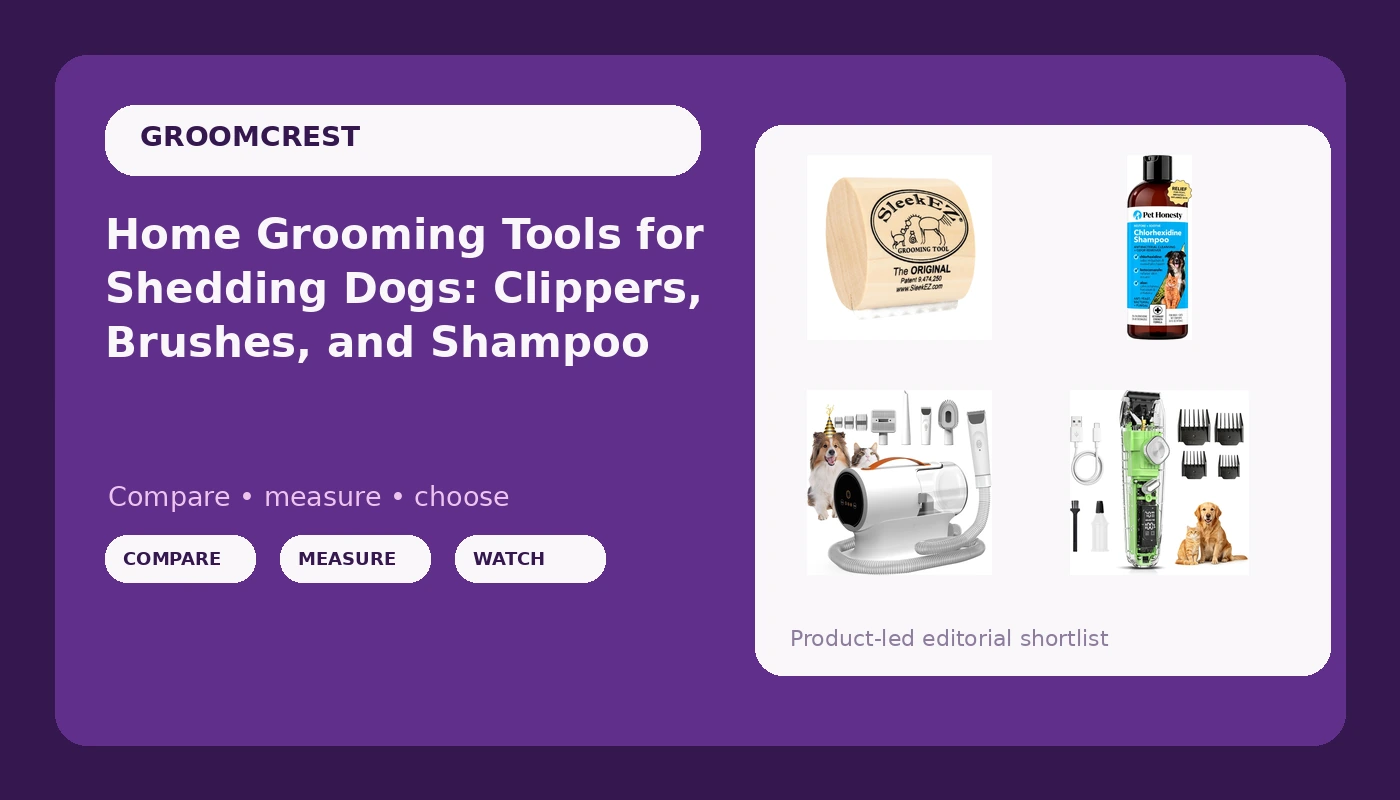
Most shedding on a kitchen floor is not really a shedding problem. It is a coat problem wearing a tool costume. The dog is dropping undercoat faster than anyone can pull it out, the brush only ever touches the top layer, and the loose fur keeps cycling back onto the couch and into the dryer filter. That is why a workable set of dog grooming tools for shedding has to do three separate jobs: lift dead undercoat, cut or trim what the coat cannot shed on its own, and calm the skin underneath so the dog stops chewing at it. The four products below cover those jobs at different price points and for different coat types, and none of them replaces the others. A vacuum kit does not replace a bath. A bath does not replace a brush. A brush does not fix a mat. Separate the jobs and the buying decision gets much simpler.
Related: How Often Should You Bathe a Double-Coated Dog? →
Quick answer
Match the tool to the coat, not to the breed name on the rescue paperwork. A double-coated dog such as a husky, golden, or lab needs a deshedding tool plus a blowout or vacuum session, and it usually needs fewer baths, not more. A dense, curly, or matted coat such as a doodle or poodle needs a clipper that will not bog down in thick hair, plus brushing often enough that mats never get started. A dog with itchy, flaky, or yeasty skin needs the right shampoo before it needs another gadget. Buy the tool that fixes the step you are actually stuck on.
Four useful options
| Model | Best fit | What stands out |
|---|---|---|
| FIXR Dog Grooming Vacuum Kit with Clippers | Owners who want fur capture and trimming in one pass | Listed at 12,000Pa suction, a 2L dust cup, a low-noise rating under 50dB, and a 5-in-1 attachment set |
| Dog Clippers for Grooming Thick Hair Curly Coats Matted Fur | Dense, curly, and matted coats that stall light clippers | Purpose-built for thick hair, curly coats, and matted fur |
| SleekEZ Cat Brush for Shedding | Cats and small dogs with loose undercoat | Patented deshedding edge, made in the USA, listed for short, medium, and long coats |
| Pet Honesty Chlorhexidine Dog Shampoo | Dogs with itchy, irritated skin | Chlorhexidine anti-itch formula in a 16oz bottle |
The all-in-one pick: FIXR Dog Grooming Vacuum Kit with Clippers
A grooming vacuum earns its counter space by solving the fur-everywhere problem, not by replacing a bath or a full groom. The suction head lifts surface hair and loose coat that would otherwise land on the floor, and the clipper attachment handles tidy-up work on feet, sanitary areas, and light trimming. The limits are worth naming: suction reaches the topcoat and the looser undercoat, but it does not blow out a packed double coat the way high-velocity air does, and it will not cut through a pelt. The 2L cup means fewer interruptions than a small-bin unit, and a low noise rating is a genuine advantage with anxious animals, though every dog reacts differently and the rating is the manufacturer's figure rather than a promise about your dog.
The thick-coat pick: Dog Clippers for Grooming Thick Hair Curly Coats Matted Fur
Coat density, not breed prestige, is what kills a cheap clipper. Curly doodle coats are springy and hold a lot of hair per square inch, and a motor that fades under load will start pulling instead of cutting, which is how dogs learn to hate the clipper. This unit is positioned specifically for thick, curly, and matted coats, which puts it in the category worth considering if your dog's legs and haunches are the part that stalls every tool you have tried. Two honest caveats. First, a clipper cannot fix a mat that is tight against the skin; the safe answer there is a short blade and a shave-down, with brushing restarted from scratch. Second, if a listing does not spell out blade sizes or motor specs, treat it as a home-maintenance tool rather than a full-groom replacement, and keep the blade cool by working in passes rather than one long run.
The deshedding pick: SleekEZ Cat Brush for Shedding
Deshedding tools sit in a strange spot in the market. They genuinely remove a lot of loose fur in a short session, and they also cause real damage when they are used like a daily brush. The reason is simple mechanics: any tool with a metal edge close to the skin can catch live topcoat along with the dead undercoat, and repeated passes over the same spot on a double-coated dog will thin the guard hairs over time. Used correctly, this type of tool is a once-or-twice-a-week job during heavy shed, worked in short strokes along the coat rather than scrubbed against the skin. The small size and curved profile make it a reasonable fit for cats, who generally tolerate a compact tool better than a full-size dog brush, and the short, medium, and long coat coverage means it can follow one household through several animals.
The bath-time pick: Pet Honesty Chlorhexidine Dog Shampoo
Shampoo is the most misread product in home grooming. Owners buy a scent they like, bathe more often to fix scratching, and make the skin worse by stripping the oils that were protecting it. A chlorhexidine shampoo works differently: it targets the skin itself rather than the coat's appearance, which is why it shows up in conversations about itchy, flaky, or yeasty dogs. Two rules apply. Read the label and follow it, because medicated-style formulas are treatments with a schedule, not a weekly bath product. And if the itching continues after a proper course of bathing, that is a vet question about allergies, parasites, or infection, not a shampoo question. For a dog whose main issue is shedding rather than scratching, a gentle oatmeal or fragrance-free formula is usually the better everyday choice.
Prices and availability may change. Product images, names, and retailer links are matched to verified listings. No current price, rating, stock status, or measured result is stated here without current evidence.
Why coat type decides the tool
Every dog you will ever groom falls into one of two structural categories, and the categories do not care what the breed name says.
A double coat is a softer, denser undercoat sitting beneath longer guard hairs. Huskies, goldens, labs, shepherds, and most spitz types are built this way. The undercoat sheds in volume, sometimes in tufts, and it is designed to insulate. This coat type should be bathed less often than owners expect, because frequent shampooing strips the oils that keep the undercoat healthy, and shedding can get worse rather than better. What it needs is mechanical removal: a line brush to separate the coat down to the skin, a deshedding tool or high-velocity air to lift the dead undercoat, and patience. It should almost never be shaved, because the coat insulates against heat as well as cold, and shaving can permanently change how it grows back.
A single coat is hair that grows continuously and sheds the way human hair does. Poodles, doodles, Yorkies, bichons, and most curly or silky breeds fall here. This coat mats rather than sheds, and the matting starts in predictable places: behind the ears, under the collar, in the armpits, along the belly, and at the base of the tail. It needs brushing every two to three days, a bath every three to four weeks, and a clipper that can handle density without heating up or stalling. A pelt, which is a mat so dense it peels off the dog like a jacket, is not a brushing problem. It is a shave-down and a fresh start.
Two specs matter across both categories. Blade temperature is the one nobody prints on the box, and metal that gets hot enough will irritate skin, so rotating between blades during a long session is standard practice. Noise is the other. A dog that lip-licks, yawns, or shows the whites of its eyes during a groom is telling you the tool is too loud or too rough, and that signal is more useful than any decibel claim on a package.
A five-step home grooming routine
- Assess with your hands, not your eyes. Run your fingers down the coat to the skin along the back, flanks, and legs. If you hit a wall of felted hair, stop and plan a shave-down instead of a brush-out.
- Line-brush first. Work in rows, parting the coat and brushing from the skin outward. This is the step almost everyone skips, and it is the reason most "my dog hates brushing" complaints exist.
- Deshed or blow out the undercoat. Use the deshedding tool, the vacuum, or high-velocity air before the bath, not after. Loose coat that comes out dry is far easier to remove than wet coat packed against the skin.
- Bath and rinse until the water runs clear. Follow the shampoo label, work it into the coat rather than the top layer, and rinse longer than feels necessary. Residue left in the coat becomes the seed for tomorrow's mats.
- Dry completely, then finish. Damp undercoat is how skin problems and matting start. Dry to the skin, then do nails, ears, and any trim work on a clean, fully dry coat.
Practical guidance for buying and using this gear
- Buy for the coat you own, not the coat you saw on a grooming video. A doodle and a husky need almost opposite tool kits.
- Treat noise ratings as a starting point and watch the dog instead. Stress signals during a groom tell you more than any number on the box.
- Keep blades cool by working in sections and rotating. Heat is the most common cause of grooming discomfort, and it is entirely preventable.
- Never use a deshedding edge as a daily brush. Short sessions, a couple of times a week during heavy shed, protect the topcoat.
- Store clippers, blades, and brushes clean and dry. Dull, dirty blades pull hair, and pulling is what makes dogs difficult for the next ten years.
Which option should you choose?
Choose the FIXR Dog Grooming Vacuum Kit with Clippers when you are tired of fur landing everywhere and want trimming plus fur capture from one device, especially for cats and small-to-medium dogs. Choose the Dog Clippers for Grooming Thick Hair Curly Coats Matted Fur when the coat itself is the obstacle, meaning dense, curly, or matted hair that lighter clippers cannot get through. Choose the SleekEZ Cat Brush for Shedding when the job is loose fur and undercoat on a cat or small dog and you want a compact tool that does not need a power source. Choose the Pet Honesty Chlorhexidine Dog Shampoo when scratching and irritation are the real problem and the shedding is a symptom rather than the cause.
One caveat applies to all four. The specifications quoted here come from the product listings, and this article states no independent measurement, price, or rating. Coat density, skin condition, and a dog's tolerance for noise and handling vary enormously, so the right tool for your dog is the one that fits the step you are stuck on.
The bottom line
Home grooming gets much easier once you stop shopping for a single miracle tool. Double coats need deshedding and blowouts with fewer baths. Curly and thick coats need regular brushing and a clipper that will not stall. Itchy dogs need the right shampoo and, if that fails, a vet. The FIXR kit handles fur capture and light trimming together, the thick-coat clipper takes on the hair that stalls everything else, the SleekEZ brush pulls loose undercoat without a cord, and the Pet Honesty shampoo addresses the skin underneath. Pick the one that matches your dog's coat type and the step you keep failing at, then learn to use it well. Technique beats gear every time.