Dog nail clipping and ear cleaning are the two home grooming jobs owners postpone the longest, and I understand the hesitation. Nails hide a live nerve. Ears carry a smell that usually means something. Both jobs take under ten minutes once you know the order, and both fall apart fast when the tool in your hand is wrong.
I have groomed dogs for ten years, the last six out of a converted cargo van that I park in driveways all over Austin. Nails are the first thing I do on every dog, before the bath, before the blade, because a dog that is comfortable having its feet handled stays comfortable for everything else. The dogs that fight me on nails are almost never difficult dogs. They are dogs whose owner used a dull clipper, took too much off, and caught the quick once.
Here is the order I run: nails first, ears second, a treat in between, and one short break that belongs to the dog. Two tools do most of the work, and neither one requires a grooming certification to use.
Why you should trust me
Ten years in the trade, six of them mobile, and I am fear-free certified, which in practice means my entire method for nails and ears is built on reading stress signals and changing the plan the moment a dog tells me the plan is not working. A dog that lip-licks, yawns, or shows the whites of its eyes through all four feet is not being dramatic. It is asking for a different approach, and the tool is almost always the reason.
The van taught me the rest. When you groom forty-odd doodles a week plus labs, goldens, huskies, and the occasional matted rescue, you learn quickly which tools hold up and which ones only look good on a box. Gear that survives the dogs stays in my kit. Gear that does not, leaves, no matter what the label promised.
How I picked and how I tested
This guide is not about a full grooming kit. It is about the two pieces of equipment that handle the jobs most owners actually attempt at home: the nail trim and the ear wipe. Everything below gets judged against the same questions I use in the van. Will it get through a set of nails without chattering or squeezing? Will a nervous dog tolerate it long enough to finish? Is it built for the coat and the nail in front of me, not for a breed on a poster? And will it still work after a year of regular use, or does it belong in a drawer by month three?
For nails, the deciding factor is the cutting edge. A clipper that squeezes before it cuts is what turns a calm dog into a biter, because the squeeze is the part that hurts, not the cut. For ears, the deciding factor is whether the tool actually gets used. A bottle of flush and a handful of cotton balls sounds thorough and gets skipped. A wipe that lives in the drawer next to the leashes gets used every week, and weekly is what keeps ears out of trouble.
The two tools worth buying first
Both of these are compact, both live in a drawer, and neither requires the dog to be muzzled or held down. If you own a medium or large dog, start here.
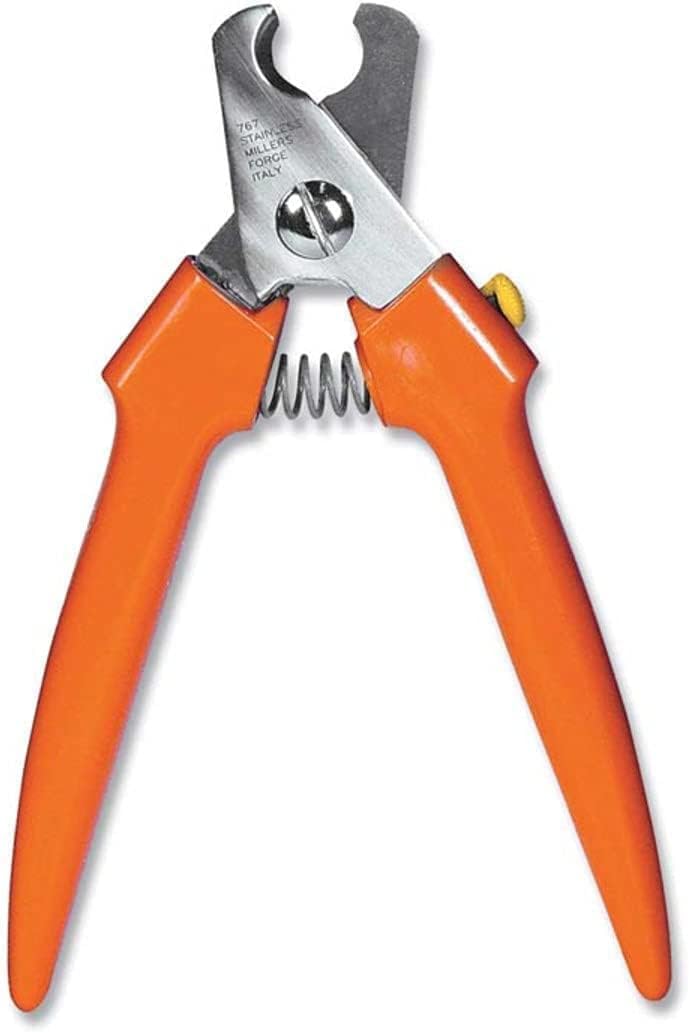
The nail clipper: Millers Forge Professional Large Nail Clipper Trimmer Stainless Steel 767C Italy
 Visit on Amazon →
This is a plier-style nail clipper with two stainless steel cutting edges that meet flush, which is exactly what you want for a medium or large dog. The plier design gives you leverage on a thick lab or shepherd nail without squeezing the toe, and the straight cutting head lets you see where the blade is about to land, which matters more on nails than any other spec. Check current Amazon price.
The reason I point owners here instead of at a guillotine clipper is the cut itself. A guillotine style punches a blade through the nail in a circle, and on a thick nail it crushes as much as it cuts. A plier-style trimmer takes a flat bite, so you can work in small slivers from the tip back and stop before you reach the quick. The tradeoff is size. This is the large model, and it is too much tool for a chihuahua, a Yorkie face, or a cat. Small dogs and cats need a small clipper, and a big clipper on a small nail is how nails get split.
Flaws but not dealbreakers: The handles are built for adult hands, and the spring benefits from a drop of oil every few months. If you leave it in a damp bathroom, dry it after use, because a spot of rust on the cutting edge is the end of a clean cut.
Anyone with a lab, a golden, a husky, a pit mix, or a standard poodle will get years out of this. Owners of toy breeds should buy the small version of the same style.
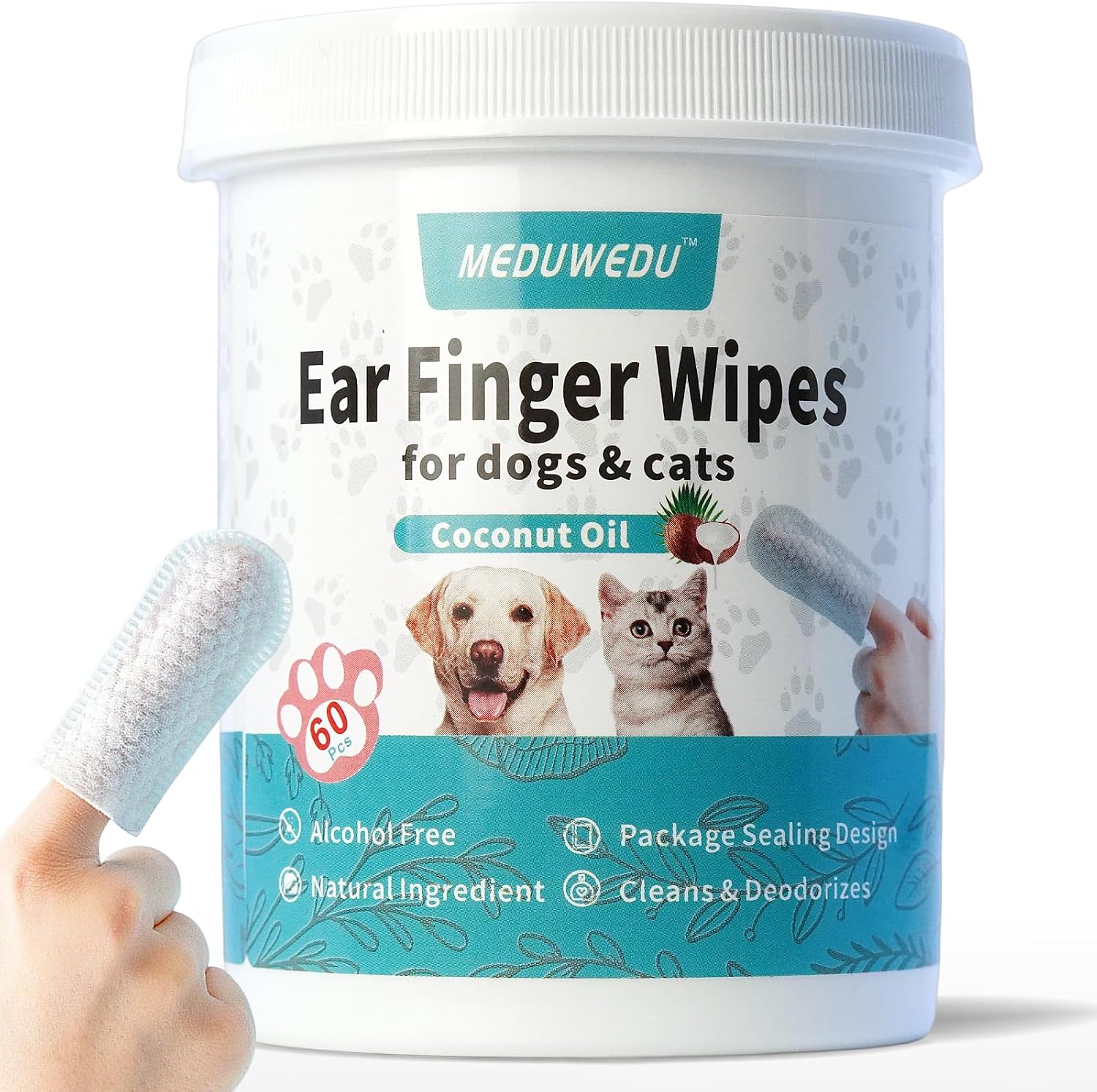
The ear cleaner: MEDUWEDU Ear Cleaner Finger Wipes 60 Counts, Dog Ear Cleaner, Grooming Kit Care for Dogs and Cats, Soft & Easy Otic Cleaning Pads, Remove Wax, Dirt & Stop Smelly, Itchy, Non-Irritating, Coconut Scent
 Visit on Amazon →
These are finger wipes, which means the pad slides over your index finger and you clean the ear with touch instead of a swab. That design choice is the whole point. You can feel the ridges and folds of the outer ear through the wipe, you can stop when the texture changes, and you cannot accidentally jam a stick down a canal. The coconut scent is light and it disappears once the ear dries, and the count is generous enough that you are not rationing them. Check current Amazon price.
Where this earns its place is the ears that need maintenance rather than treatment: the floppy-eared dog that collects gunk every couple of weeks, the dog that comes out of the lake with wet ears, the doodle with hair growing in the canal opening. Wipe the parts you can see, the inside of the flap, and the pocket just below the opening, and you remove the wax and debris that feed the yeasty smell owners complain about.
Flaws but not dealbreakers: A wipe cleans the outer ear only. It is not a flush and it will not reach an infection, and no wipe should ever be pushed into the canal. If your dog has a head tilt, a discharge, a hot ear, or pain when you touch the base of the ear, that is a vet visit, not a wipe. The scent is a fragrance, so a dog with known skin allergies should start with one wipe and a look at the ingredients.
Anyone who has ever said "I know I should clean his ears more often" will actually use these, because they take thirty seconds and require no cotton balls.
How to clip dog nails without hitting the quick
The quick is the pink nerve and blood supply that runs down the middle of the nail. On a white nail you can see it. On a black nail you cannot, and that is the nail that makes owners nervous. Here is how I do it.
Step one: read the nail before you cut. Look at the nail from the side and from underneath. On a black nail, the tip curves down and the quick sits back inside the curve. If the nail is long and hooked, the quick has grown out with it, so you are taking off less than you think. Start with the tip only.
Step two: get the dog off the floor. A dog on the floor has leverage, and you do not. A counter with a non-slip mat, a low table, or a second person holding the dog steady against their chest all work. Never trap a dog in a corner, and never scissor your legs around a dog to hold it still. That is how bites happen.
Step three: hold the paw, not the toe. Support the leg under the wrist so the dog is not dangling its own weight, and take one nail at a time. Place the cutting edges so the blade is perpendicular to the nail, and cut straight across the tip. A clean cut leaves a flat face. A crushed or split edge means the clipper is dull or the wrong size, and you should stop and change tools rather than keep going.
Step four: take slivers, not slices. Small bites from the tip back, checking the cut face after each one. When you see a gray-pink oval in the center of the nail, the quick is one thin sliver away. Stop there. If you do catch the quick, press a pinch of styptic powder or cornstarch on the tip and hold pressure for a minute, then give the dog a real break.
Step five: do not forget the dewclaws. The nails on the inside of the leg, up near the wrist, do not touch the ground, so they grow in a curl and can eventually grow into the pad. They get trimmed on the same schedule as everything else, and on some dogs they are the only nail that matters.
Step six: reward after every paw, not after all four. A dog that learns one paw equals one treat will offer the second paw. A dog that learns four paws equals one treat at the end learns that the trim is a long ordeal.
How to clean dog ears the way a groomer does
Step one: look and smell first. A healthy ear is pale pink, mostly dry, and smells like almost nothing. Brown wax, redness, a sweet or yeasty odor, or a dog that flinches when you touch the base of the ear are all reasons to stop and call the vet.
Step two: clean what you can see. Slide a finger wipe over your index finger, lift the ear flap, and wipe the inside of the flap, the folds, and the pocket below the opening. Use a fresh wipe per ear, because you do not want to move debris from one ear into the other.
Step three: leave the canal alone. The ear canal is L-shaped, and it turns before it reaches the eardrum. A cotton swab cannot follow that turn, so all it does is pack wax and dirt deeper against the drum. If your vet has given you a flush solution for the canal, use it exactly as directed, and follow up with a wipe on the outer ear to catch what comes back out.
Step four: dry, then leave it. Moisture in the ear is what yeast loves, so pat the ear dry, let the dog shake, and put the wipes away. Daily cleaning of a healthy ear irritates the skin and strips the natural defenses. Every week or two is plenty for most dogs, and floppy-eared dogs or swimmers go on the shorter end of that.
Step five: know what you are looking for. Recurring odor within a day or two of cleaning, head shaking, scratching at one ear, or a discharge means the wipe is no longer the right tool. Ear infections are common and they are a vet job. Cleaning an infected ear at home just delays treatment and makes the dog ear-shy for the next person who tries.
What to do when the dog says no
Nail trims fail because owners treat a stress signal as disobedience. Lip licking, yawning, turning the head away, pulling the paw back, freezing, and that sideways glance that shows the whites of the eyes are all the dog telling you the pace is too fast. You are not negotiating with a toddler. You are reading a nervous system.
The fix is splitting the job. Do one paw tonight and the rest tomorrow. Do two nails, then stop and put the clipper away. Handle the paws with no clipper in sight for a week, touching each toe and treating, so the paw stops predicting the squeeze. A dog that gets three calm nails a day for a week ends up with better nails than a dog that gets all sixteen in one wrestling match.
If the dog is genuinely panicked, is snapping, or has nails so overgrown that they are curling, that is not a home job. Book a groomer or a vet. A professional trim takes minutes, and it resets the dog's association with the whole process. Some dogs need a vet visit for a nail trim for the rest of their lives, and there is no shame in that. There is only a dog with long nails and sore feet if you keep trying to win.
The tools that lose to these two
Human nail clippers crush a dog's nail instead of cutting it, and the curved blade cannot get around the nail to make a flat cut. Guillotine clippers work on a thin nail and struggle on a thick one, which is why they end up in junk drawers. Scissors are worse, because the dog moves and the scissor blade does not care what it catches.
Cotton swabs are the tool I would ban from every dog household. I have watched more ear damage come from swabbing than from any infection, and the wax that gets packed against the drum is harder to remove than the wax that was sitting near the opening.
And the "grooming gloves" and slicker brushes marketed for nails and ears do nothing for either job. Brush all you want. The nail still grows, and the ear still needs a wipe.
What this all costs
Two tools, and neither one is a splurge. A clipper that holds an edge and a box of finger wipes together cost less than a single salon visit for nails and ears in most cities, and they cover months of home maintenance. Check current Amazon price on both and do the math against one professional nail trim, and the case makes itself.
The real cost is time, and it is paid up front. A week of paw handling with no clipper, a few short sessions instead of one long one, and a treat after every paw. That week is what separates an owner who grooms their own dog comfortably for the next decade from an owner who drives to a salon every six weeks and apologizes for the nails.
The order matters as much as the tools. Nails first, ears second, break in between, and the dog decides when the break happens. Clip the tip, stop before the quick, wipe what you can see, and never swab. That is the whole job, and most dogs will let you do it without a fight once the tools are right.