Most at-home dog grooming tools fail on the first dog, and it is almost never the tool's fault. It is the order of operations. People buy a clipper, skip the line brushing, skip the dryer, then push a blade through a coat that was never ready for it, and the dog learns to hate the table before the second groom.
I have groomed dogs for ten years, the last six out of a converted cargo van I park in driveways all over Austin, and I run forty-odd doodles a week plus labs, goldens, huskies and the occasional matted rescue that shows up in a trash bag. The at-home dog grooming tools in this guide are the two I would hand a first-timer: a cordless clipper kit that also covers nails, and a self-cleaning undercoat rake for the double coats that shed year-round.
Here is the exact sequence I use, what each tool is actually for, and where home groomers go wrong.
Why you should trust me
I started at 19 as a bather at a strip-mall salon, and on my third week the only groomer quit mid-shih tzu. The dog was half-pelted and the owner was already in the lobby, so I finished it with a 10 blade, a lot of patience and a bruised thumb. I have been finishing other people's dogs ever since.
The van changed how I judge gear. There are no salon walls to absorb noise, my 3,000-watt inverter limits which dryers I can run, and the dog sits six inches from the motor instead of across the room. After a hot A5 blade gave a golden retriever a mild blade burn one July, I bought an infrared thermometer and logged every blade temp for a month. The job book in my van holds decibel readings from a cheap dB meter, runtimes timed on my phone, grams of undercoat weighed on a kitchen scale, and how many dogs each tool survived before it let me down. That book is what these recommendations come from.
How I picked and how I tested
Two rules decide whether a tool gets recommended here. First, it has to run through a full coat without bogging or heating up. Second, it has to work on a nervous dog, because a tool that only works on a calm, cooperative lab works on maybe one dog in five.
For clippers I run the same check every time: real fur on a real coat, blade temp logged every ten minutes, and a count of stress signals, which means lip licks, yawns and whale eye. Anything over 110 degrees on the blade comes off the dog. For rakes and deshedding tools I weigh the fur that comes out on the kitchen scale, then look at the topcoat for damage, because the fastest way to ruin a husky is a tool that cuts live coat.
Noise is not a preference in my book, it is a stress test. A dog that lip-licks and yawns through a groom is telling you the tool is too loud, so I measure every motor at the dog's ear and the quiet tools are the ones that get used on puppies and rescues. Runtime is measured in dogs, not minutes. If it dies before the third dog, it dies.
What you need before the first cut
Home grooming fails at the same three steps every time: no table, the wrong blade, and no dryer. Fix those three and you can groom most dogs at home with a modest kit.
A non-slip surface at waist height. Grooming on the floor wrecks your back and teaches the dog to spin away from you. A stable table with an arm changes how a dog behaves, I promise.
A blade or guard that matches the coat. A 10 blade is the close-cutting workhorse. Snap-on combs give you length over a blade, and cheap ones pop off mid-leg on a curly coat.
A way to dry the coat down to the skin. A human hair dryer is too hot, too weak and takes forty minutes to half-dry a lab. A damp undercoat mats in hours.
A grinder or clipper for nails. Black nails hide the quick, and clippers find it faster than a grinder does.
A rake for undercoat. Double coats need the dead undercoat lifted out, not cut off.
The two tools that earn their spot in the van
Two tools cover the bulk of a home groom. Neither is a substitute for the other, and buying both costs less than a single full groom on a doodle in most cities.
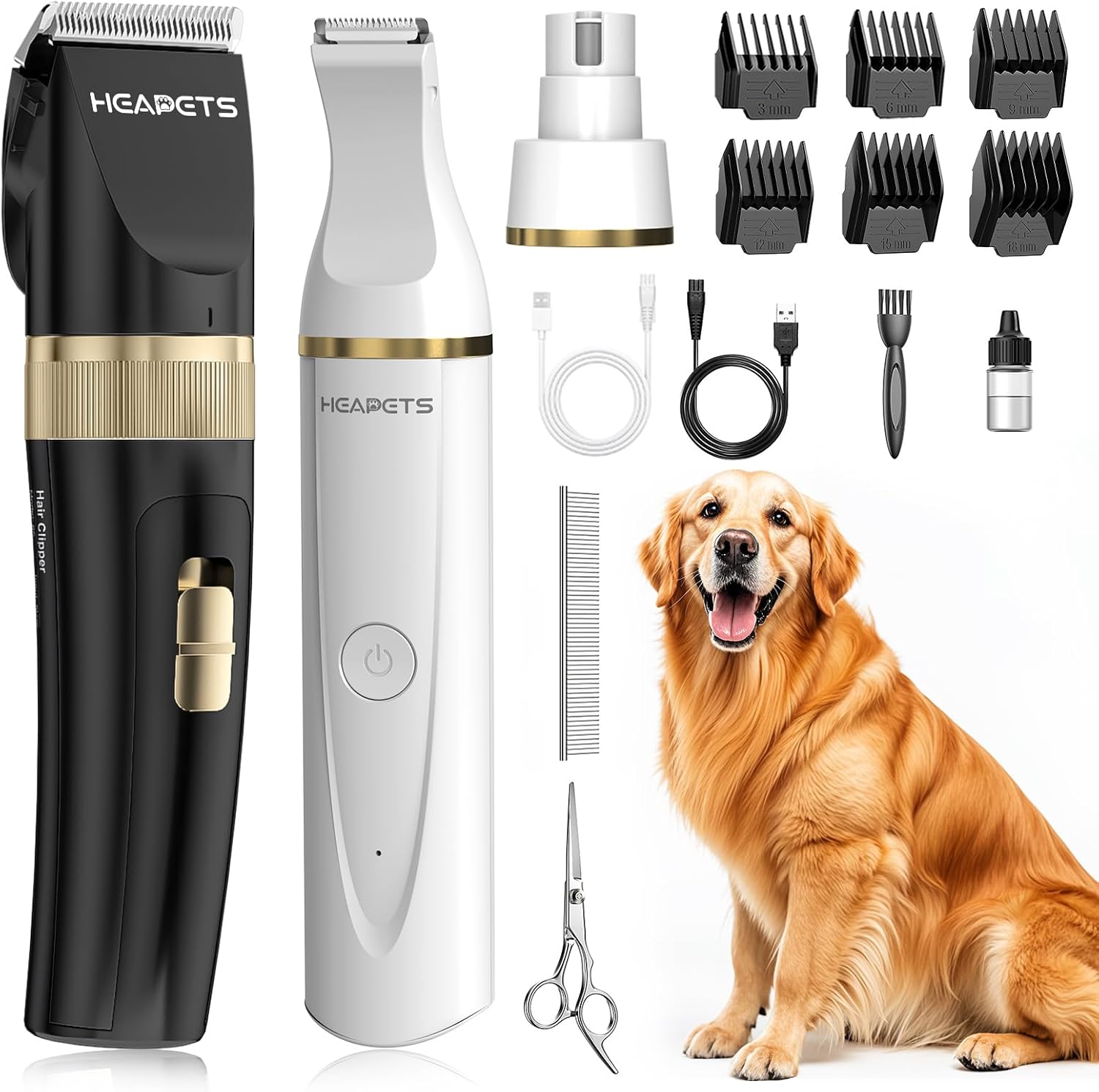
The all-in-one kit: HEAPETS Dog Hair Clippers for Grooming Kit and Dog Paw Trimmer Nail Grinder for Grooming, Low Noise Rechargeable Cordless, Shaver Grooming Supplies for Pet Cats Dogs (Black, White)
 Visit on Amazon →
Check current Amazon price, and what you get is a cordless clipper plus a paw trimmer and nail grinder in one box. This is the kit I hand a first-timer with one small to medium dog. It is rechargeable and built around low noise, which matters more than the marketing suggests, because the dog is right next to the motor and the first groom decides whether there is a second one. The clipper does the body work. The trimmer covers paw pads, sanitary areas and face touch-ups, which is where most of a home groom actually lives, and it means you are not buying a separate tool for nails.
What I would check on any kit in this class: blade temperature after ten minutes of continuous cutting, whether the guard stays seated on a curly coat, and whether the motor holds its speed in thick fur. Run it on the dog's back before you go near a face, and give it a rest if the blade gets warm against your wrist. A warm handle today is blade burn tomorrow, and blade temperature is the number nobody prints on the box.
Flaws but not dealbreakers: this is a home kit, not a pro clipper. It will do a Maltese, a Yorkie or a shih tzu all day and it will slow down on a lab's haunches if you lean on it. If your dog has a dense double coat, clip less and rake more.
Who it is for: the owner of one small to medium dog who wants to trim between professional grooms and stop paying for nail trims.
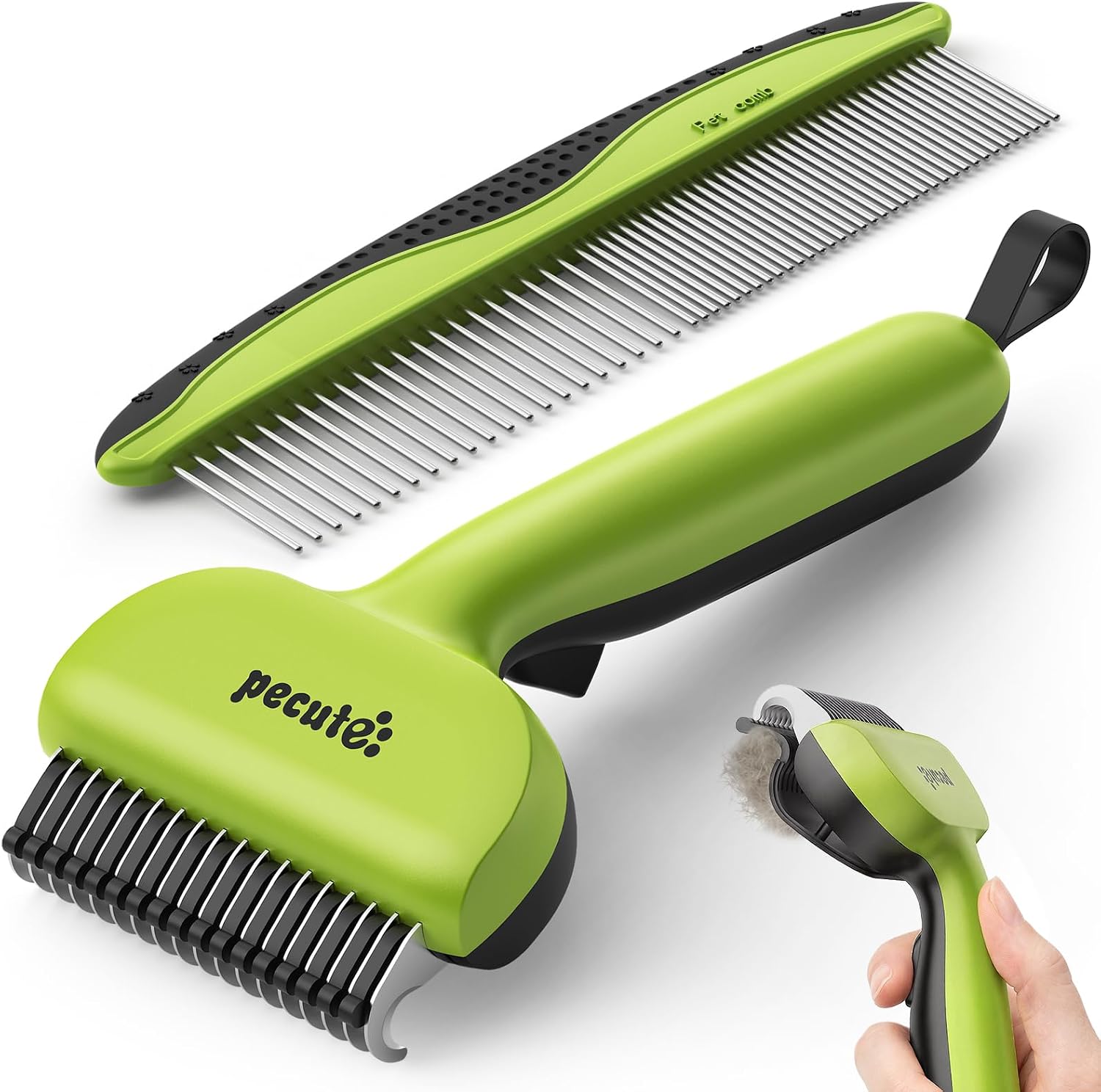
The undercoat tool: Pecute Self-Cleaning Undercoat Rake for Dogs Cats with Long/Double Coats
 Visit on Amazon →
Check current Amazon price, and you have the one tool that reaches the layer a brush cannot. Every dog is a double coat or a single coat, and the answer is different for each. If you own a husky, a golden, a lab, a shepherd or a long-haired cat, the fur you are fighting lives under the topcoat. A slicker brush works the surface. A rake gets underneath it.
The self-cleaning mechanism matters more than it sounds. The retractable teeth let you clear the tool with one hand while the other hand holds a dog that has decided the couch was a better idea. That keeps the session short, and short sessions are the only ones a shedding dog tolerates twice a week.
Use it in the direction of the coat, in short strokes, section by section, and stop when the teeth come up clean. Two things to watch: never rake over a mat, because a rake will pull skin and you cannot fix a matted dog with a gentle tool, and never rake a single-coated dog, because there is no undercoat to lift and you are only scraping the topcoat.
Who it is for: double-coated dogs in shedding season, plus long-haired cats that will not tolerate a slicker.
The actual workflow, step by step
Step one: read the dog before you touch a tool. Lip licks, yawns and whale eye mean the dog is not ready. Give it five minutes on the table with nothing running. A dog that settles gets a better groom, every time.
Step two: brush the coat out before you cut anything. Line brush the whole dog. If you find a mat, stop and deal with it. You cannot clip through a pelt without hurting the dog, and matted dogs get shaved down and started over. That is not a failure, it is the honest answer.
Step three: rake the undercoat, if your dog has one. Short strokes, in the direction of the coat, working in sections. Stop when the rake comes up clean. On a husky in shedding season that is 8 to 12 grams of dead fur on my kitchen scale, and it is fur the clipper should never touch.
Step four: nails before the bath. Grind or clip while the dog is calm and dry. Wet nails are slippery and the quick is harder to see. On black nails, take small passes and look at the end of the nail between each one.
Step five: bath and rinse properly. Rinse time is the spec nobody prints on the bottle. If the coat still feels slick after two rinses, keep going. Residue turns into mats.
Step six: dry all the way down to the skin. This is where home grooms fail. A damp undercoat mats within hours and smells by tomorrow. If you do not own a high-velocity dryer, towel hard and keep the dog warm until the coat is dry at the skin.
Step seven: clip or trim with a cool blade. Body work first, face and paws last. If the blade is too warm for your wrist, it is too warm for the dog. Rotate between two blades if you have them, the way a line cook rotates pans.
Step eight: finish with scissors only where scissors belong. Around the eyes, the paws and the sanitary areas. If you are nervous with shears near a face, use the trimmer attachment instead. Nobody is grading you.
Step nine: clean the tools before you put them away. Hair packed in a blade is the fastest route to a dull blade and a hot blade. Brush the blade out, oil it, and store it dry.
How often to groom, by coat type
A double-coated dog, so a husky, a golden, a lab or a shepherd, needs a bath every 6 to 8 weeks. Shampoo strips the oils that keep the undercoat healthy, so over-bathing makes shedding worse, not better. The rake and a blowout do more for a double coat than any shampoo.
A single-coated dog, so a poodle, a doodle, a Yorkie or a bichon, can go every 3 to 4 weeks. That hair grows continuously and mats fast, so bathing plus brushing on a schedule is what keeps a dog off the shave-down list.
Dogs with skin allergies or medical conditions bathe on the vet's schedule, not mine. Medicated shampoos are treatments, and extra baths can make a skin dog worse.
The real schedule is brushing. Double coats get a line brush and a rake twice a week. Single coats get a full brush-out every two to three days. The bath schedule matters less than the brush schedule, and I will die on that hill.
The mistakes that turn a groom into a shave-down
- Raking a matted coat. A rake on a pelt pulls skin. Mats get shaved, not brushed out.
- Clipping a dirty coat. Dirt dulls a blade faster than fur does, and a dull blade runs hot.
- Pushing a warm blade. 110 degrees is the line, and above it you are one pass away from blade burn.
- Skipping the dryer. A damp undercoat mats in hours and smells by the next day.
- Using a rake on a single coat. There is no undercoat to lift, so you are just scraping topcoat.
- Trusting the word quiet on a box. Measure it or watch the dog's ears and lip licks instead.
- Buying a kit for the attachments you will never use. Buy the tool that matches the coat you actually own.
What this all costs
Check current Amazon price on both tools and you are still under the cost of one full groom on a doodle in most cities. Two or three grooms and the kit has paid for itself, nails included.
- The kit covers body clipping, paw pads, sanitary trims and nails.
- The rake covers the undercoat a clipper should never touch.
- The salon visit you skip is the math that actually matters.
Home grooming is not a cheaper version of a professional groom. It is a maintenance routine, and the dogs that do best on it belong to owners who brush between baths and know when to stop. Clip less, rake more, keep the blade cool, and read the dog before you read the box. That is the whole job.