Every March my van fills up with huskies, goldens, and labs whose owners have already tried the brush, the vacuum, and the shop vac. The coat keeps coming anyway. Nine times out of ten the problem is not the dog. It is the order of operations and the wrong two tools.
A real dog dryer and undercoat rake, used in the right sequence, will lift more loose fur off a double coat in one session than a month of brushing on the living room floor. I know because I weigh it. The kitchen scale in my van does not care what the box promised.
This is the routine I run on every double-coated dog that comes through the van door, and it is the same routine I hand to home groomers who want to stop vacuuming their couch twice a day.
Why you should trust me
I have groomed dogs for ten years, the last six out of a converted cargo van I park in driveways all over Austin. Forty-odd doodles a week, plus labs, goldens, huskies, and the occasional matted rescue that shows up in a trash bag. I am fear-free certified, which mostly means I watch the dog instead of the clock.
The van is what made me start measuring. There are no salon walls to absorb noise when the dog is six inches from the motor, and a 3,000-watt inverter limits what I can run. So I bought a cheap dB meter, an infrared thermometer, and a kitchen scale, and I started writing numbers in the job book next to every tool. Blade temps logged every ten minutes. Dryer runs timed to 90% dry on a wet coat. Undercoat weighed in grams. Stress signals counted per paw.
If a tool did not survive the dogs, it does not survive the review. That is the whole editorial policy.
How I picked and how I tested
This article is not about which clipper to buy. It is about the two tools that handle shedding and drying, and how to use them without wrecking a coat or a back.
Every dryer I write about gets the same test. A wet, freshly bathed dog, a stopwatch, and a target of 90% dry. I measure the outlet temperature, not the dial setting, because the dial lies. I take a decibel reading at the dog's ear, not at my own, because that is where the stress happens. Then I watch the dog. A dryer that hits its numbers and scares the dog still fails.
Every deshedding tool gets the same treatment. It goes over a dry double coat in lines, and whatever it pulls goes on the scale. Then I inspect the topcoat for cut or broken guard hairs, because a tool that pulls fur by cutting it is not deshedding, it is thinning.
The two numbers that decide everything for me: grams of undercoat removed per ten minutes of work, and outlet temperature in degrees. Everything else is a sticker on the box.
The two tools that do the work
You need one tool to move air and one tool to lift dead coat. That is the whole kit. Everything else in the shedding aisle is optional.
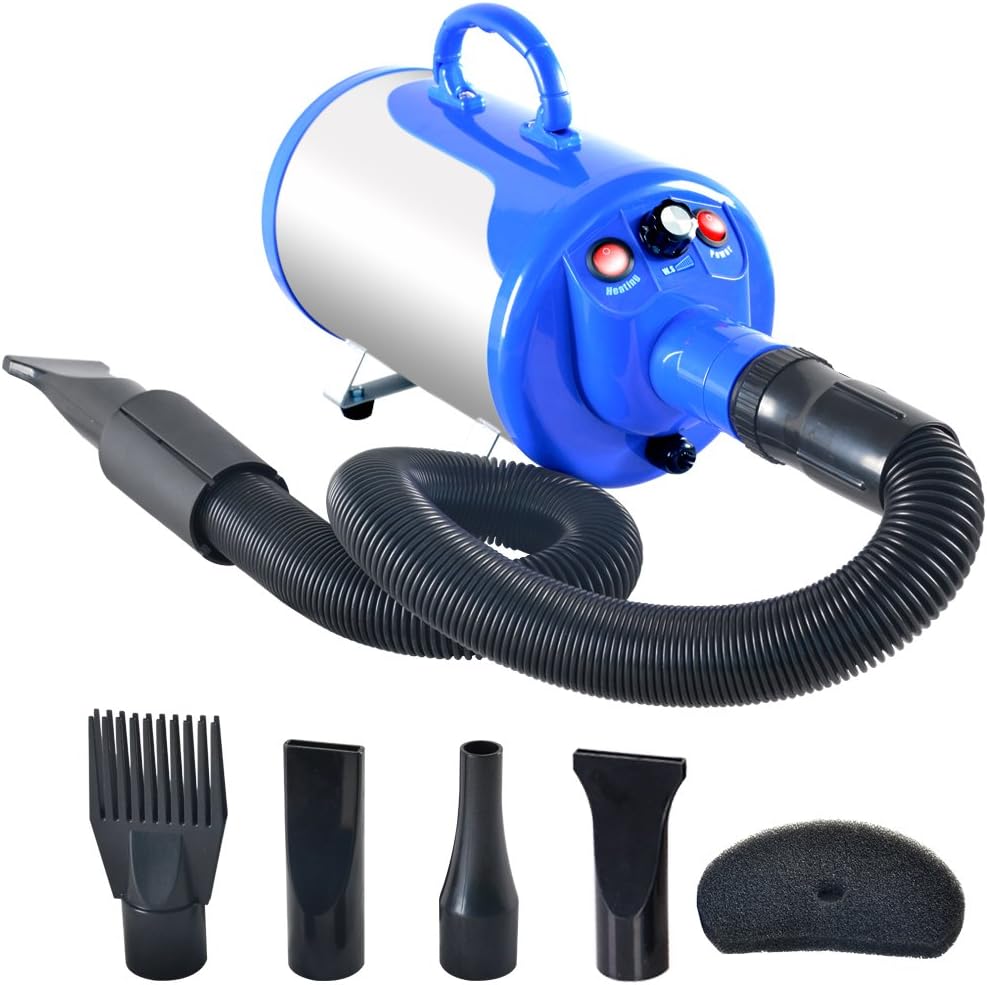
Our pick for the air: SHELANDY Groomer Partner Pet Hair Force Dryer Dog Grooming Blower with Heater (Blue)
 Visit on Amazon →
This is the budget high-velocity dryer that surprised me. It has real force and usable heat control, and on a golden retriever with a soaked undercoat I timed it at about twenty minutes to dry. That is not a pro-tier time, but it is in the same conversation, and it is roughly half of what the jet-engine dryers cost.
The heater is the part home groomers underrate. Most cheap dryers have one setting called warm, and warm on a forty-dollar unit can sit at 140 degrees at the nozzle, which is a burn waiting to happen on a shaved belly or a thin-skinned flank. Having a dial you can actually turn down matters more than having more power.
Flaws but not dealbreakers: The hose is stiff, especially in cold weather, and it fights you when you are trying to get under a belly. The noise is real, so ear protection for you and a slow introduction for the dog are not optional. Start it in the next room, then the same room, then on the dog's back leg before you ever point it at the head.
This is the one I recommend to DIYers with big dogs. If you own a husky, a golden, a lab, or a shepherd, you need moving air more than you need another brush. Fifteen minutes of high-velocity air before the bath lifts more dead coat than any tool you can hold in one hand.
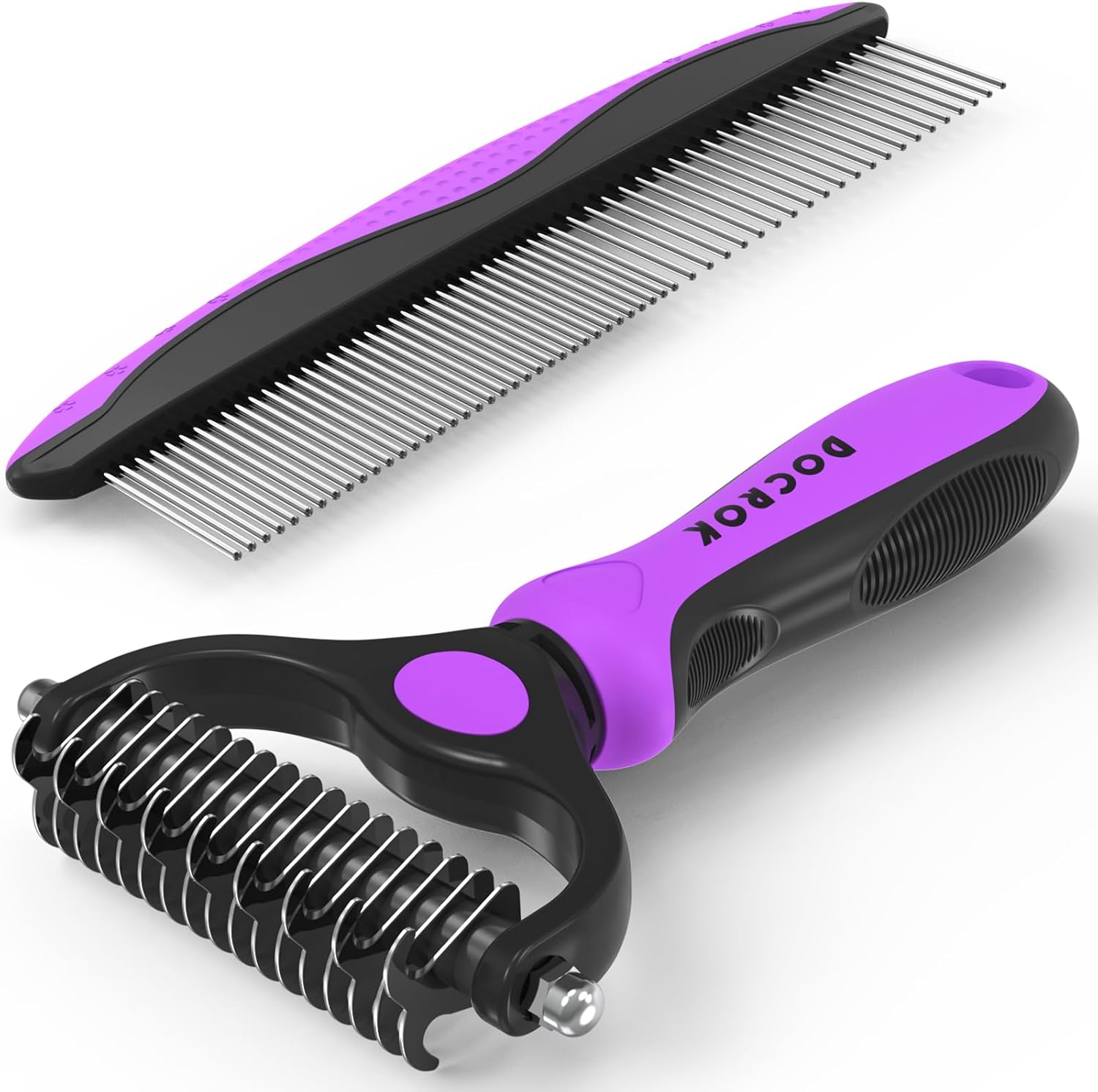
Our pick for the rake: Docrok Pet Grooming Brush and Metal Comb Combo - Undercoat Rake for Dematting and Deshedding Long Matted Haired Dogs and Cats, Purple
 Visit on Amazon →
This is a two-piece set, and the second piece is the reason I point people to it. The rake does the lifting. The metal comb does the telling, because a comb is the only honest test of whether you are finished.
The rake has to be worked in lines, not scrubbed in circles. Part the coat with one hand, lay the rake in at the skin, and pull straight out along the grain in short strokes. Then move an inch over and do it again. Circles and long drags are how people rake a dog raw and then blame the tool.
The comb is what separates a real deshed from a hopeful one. After you rake a section, run the comb through it. If the comb glides from skin to tip with no snag, that section is done. If it catches, there is still loose undercoat in there and you go back in. Comb first, rake second, comb again. That loop is the whole technique.
The dematting claim on the label deserves an honest caveat. This combo handles light tangles and the felted clumps that form behind the ears and in the armpits on a coat that gets brushed most weeks. It is not a pelt remover. A mat so dense it peels off the dog like a jacket does not get brushed out by any rake, no matter what the listing says. That dog gets shaved down with a 10 blade and a conversation about brushing, and I have had that conversation several hundred times.
Flaws but not dealbreakers: The caveat is not the tool, it is the hand holding it. Light pressure, short strokes, and a stop when the dog starts lip licking. A rake used with force on a thin-coated dog will scratch skin, and a rake used on a damp coat will pull and snag instead of lifting.
This set is the one I hand to home groomers with a double coat and no plans to show the dog. It covers the rake and the finish comb in one purchase, which is more than most brush-and-comb bundles manage.
The drying and deshedding workflow
Now the part that matters. This works on any double-coated dog, and it works in a driveway or a laundry room.
Step one: Read the coat before you touch a tool. Run your hands through the coat down to the skin. You are checking two things: is there a pelt anywhere, and where does the coat feel thickest. Behind the ears, the armpits, the base of the tail, and the britches are where mats start. If you find a pelt, stop. That is a shave-down, not a deshed.
Step two: Blow the coat out before the bath. This is the step almost everyone skips, and it is the step that solves the shedding problem. Dry, dead undercoat lifts with air. Wet it and it turns into felt that clings to the topcoat and mats tighter. Run the dryer over the whole dog on low heat, working in the direction the hair grows, and watch the cloud come off.
Step three: Rake what the air loosened. Now the coat is standing up and the dead undercoat is separated. Work in sections the width of your rake, part the coat, and rake along the grain. Keep a trash bag or a bin next to you, because you will fill it.
Step four: Comb the section to check it. Metal comb, skin to tip. If it drags, go back over that section. This is the loop that keeps you from calling a coat done when it is half done.
Step five: Bathe, and time your rinse. Use a shampoo that rinses clean in two passes. Rinse time is the spec nobody prints on the bottle, and a shampoo that takes four rinses to stop feeling slick leaves residue that turns into mats. Warm water, not hot, and work the shampoo down to the skin instead of lathering the topcoat like a wig.
Step six: Dry to the skin, not to the surface. A double coat holds water against the skin long after the topcoat feels dry. Set the dryer heat low enough that the air on your wrist is warm, never hot, and keep the nozzle moving. Never park it in one spot. Never point it at the face, eyes, or ears. If the dog starts yawning or lip licking, back off the heat or the speed before you continue.
Step seven: Comb the whole dog one more time. Drying lifts more loose coat, so the comb test comes back at the end. Anywhere the comb catches after drying is a spot that will mat in the next two weeks.
Step eight: Set the schedule. A double coat gets raked and combed twice a week and blown out every six to eight weeks. Bathing more often than that strips the oils that keep the undercoat healthy, and over-bathing a husky makes the shedding worse, not better.
Where home groomers go wrong
The mistakes are consistent. I see the same four every week.
The first is the human hair dryer. It is too hot and too weak. I timed one at forty minutes to half-dry a lab, and by then the dog was done with the whole experience. If you own a double coat, buy a real dryer or accept the wet-dog life.
The second is raking a damp coat. Rakes lift dry, dead undercoat. On a wet coat they snag and pull live hair, and the dog learns that the rake hurts.
The third is raking a pelt. There is no gentle tool that fixes a pelt. Mats that tight have already pulled the skin, and working a rake through them hurts the dog and damages the coat you were trying to save.
The fourth is treating a blade-style deshedding tool as a daily habit. Those tools pull a shocking amount of fur, but they also cut live topcoat if you oversweep. It is a tool for a specific job on a specific day, not a lifestyle. If you are using one every night on the couch, you are thinning the coat you are trying to keep.
Tools that do not do this job
A slicker brush is a finishing and detangling tool, not a deshedding tool. It does not reach the undercoat, and if you are using it as your only tool on a husky, you are brushing the topcoat while the undercoat packs in.
A grooming vacuum is a maintenance tool for between grooms. It is genuinely useful on cats and small dogs, and I use one weekly. It cannot reach a dense undercoat, and it is not a substitute for a blowout.
Chews, oils, and supplements do not stop a shed. They can support skin health, and that is a different conversation. The fur that is already dead comes out with air, a rake, and a comb.
What this costs
Two tools, one routine. A high-velocity dryer and a rake-and-comb set cover the entire job, and both are one-time purchases. Check current Amazon price on each and do the math against a single deshedding appointment, then against a summer of vacuuming.
The dryer is the bigger spend and the one that changes the most, because moving air is what actually solves shedding on a double coat. The rake and comb set is the smaller spend and the one that tells you when you are finished.
Buy the two, learn the order, and stop fighting the couch. Your dog's coat has been waiting for you to dry it before you bathe it. Do that once and you will never go back.