Most home grooms fall apart in the same three places: the dog is on the floor, the blade is too hot, and the clippers are being asked to do a job that belongs to a pair of shears. Dog grooming clippers and shears are the two tools that cover almost everything a doodle, a shih tzu, or a golden retriever needs between salon visits, and the order you use them in matters more than which name is stamped on the handle.
I groom forty-odd dogs a week out of a converted cargo van in Austin. That means no salon walls to absorb sound, a dog sitting six inches from the motor instead of across the room, and a job book full of notes about what actually held up. I have finished a lot of half-done home grooms, and the pattern is almost always the same: the owner bought decent tools and then used them in the wrong order, on the wrong part of the dog, with a blade that had been running hot for ten minutes.
This is the order I use. Two tools, a short list of steps, and the caveats that never make it onto the box.
Why you should trust me
I have been grooming for ten years, the last six mobile. I started at nineteen as a bather at a strip-mall salon, and in my third week the only groomer quit in the middle of a shih tzu. The dog was half pelted, the owner was already in the lobby, and I finished it with a 10 blade and a bruised thumb. I have never really stopped finishing other people's dogs.
I am fear-free certified, which in practice means I read the dog before I read the clock. Lip licks, yawns, and whale eye are data. A dog that tells me the tool is too loud gets a different tool, not a pep talk. I own three clippers I actually use, and I have strong opinions about every gadget that promises to make grooming easy. The van is the truth teller: gear that works in a quiet salon and gear that works in a hot van with the inverter humming are not the same gear.
How I picked and how I tested
Nothing gets recommended here off a spec sheet. Every clipper I write about gets run through a full coat, not a swatch on a forearm. I want to see how it behaves on thick, matted, or curly hair, how the blade feels after ten minutes of continuous work, and whether the handle gets warm in my hand, because a warm handle means a warm blade and the dog feels that long before I do.
Shears get the paper test first. A shear should cut a sheet of copy paper cleanly from the pivot all the way to the tip. A shear that drags on paper will drag on a face, and dragging on a face is how dogs get nicked.
Then the dog test. I watch for stress signals the whole time: lip licks, yawning, a stiff body, a tail tucked under. If a tool makes a dog lip-lick through all four feet, it goes in the two-person column, no matter how good the spec looks.
The two picks below both survived the van and the dogs.
The two tools that do the work
One clipper, one pair of shears. That is the whole kit for a dog you plan to groom at home every four to six weeks. Everything else is supporting cast.
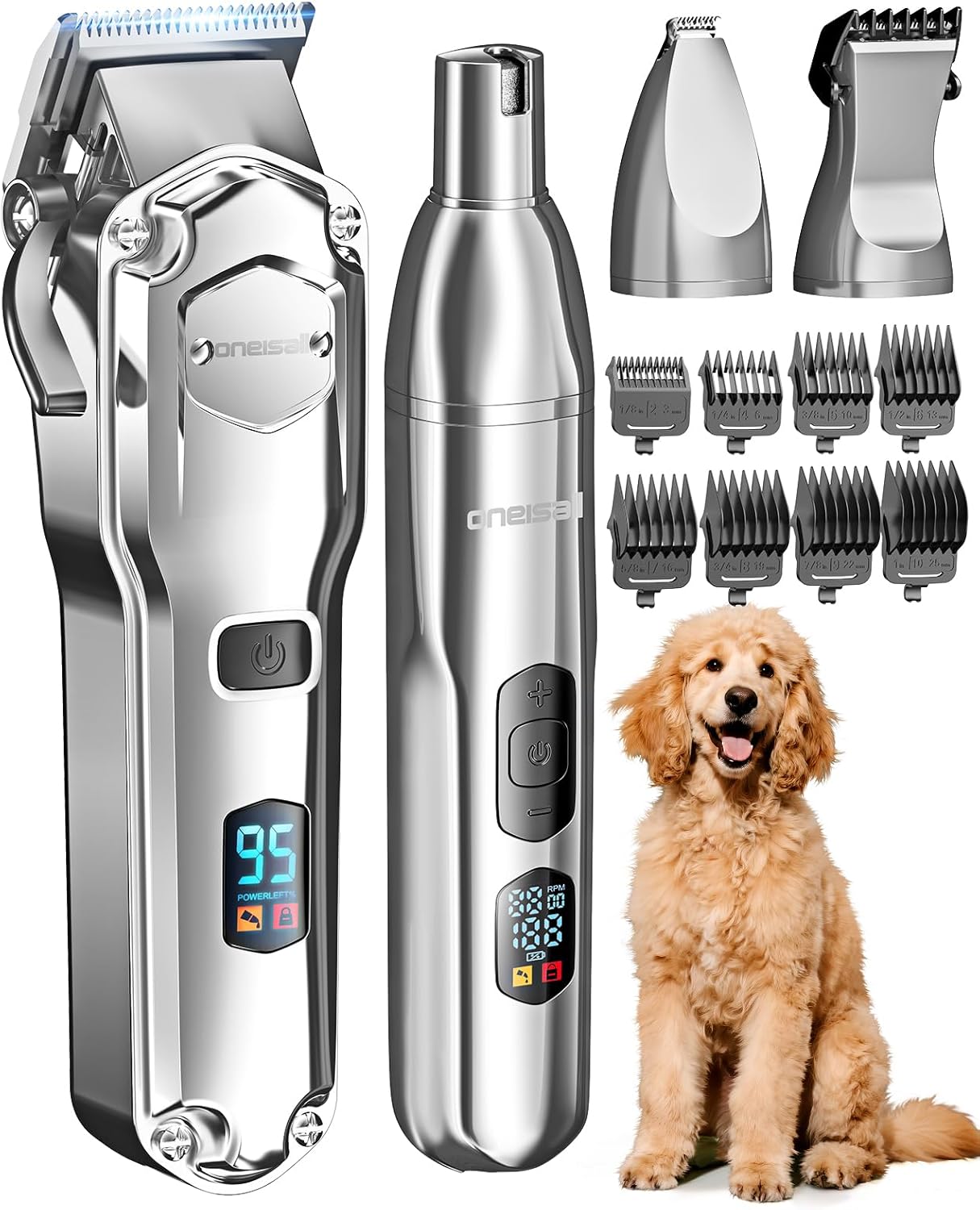
Our pick: oneisall Dog Clippers for Grooming Thick/Matted Hair, 4-in-1 Grooming Kit
 Visit on Amazon →
This is the kit I hand to someone grooming their own dog for the first time. It is built for thick and matted hair, which is exactly the coat that makes cheap clippers bog down and stall halfway up a leg, and the 4-in-1 framing means you are not buying the attachments separately and finding out they do not fit.
The honest limit is coat density. A clipper at this level will do a Maltese all day and will slow down on a lab's haunches or a doodle's hind leg if you push it. That is not a defect, it is physics: the motor is sized for a home groomer doing one dog every few weeks, not for me running six dogs back to back. Work in overlapping passes, let the tool cut at its own pace instead of forcing it, and you will get a clean body clip out of it.
Flaws but not dealbreakers: The blade dulls faster than a pro blade, so factor in replacing it if you groom monthly. The motor fades on genuinely thick double coats. And like every cordless kit, the battery is the part that ages first, so charge it before the groom, not during it.
Anyone with a doodle, a poodle cross, a shih tzu, or a small-to-medium dog that needs a body clip every month or two will get real use out of this. If you own a husky, buy a dryer and a rake instead and let a groomer handle the clip.
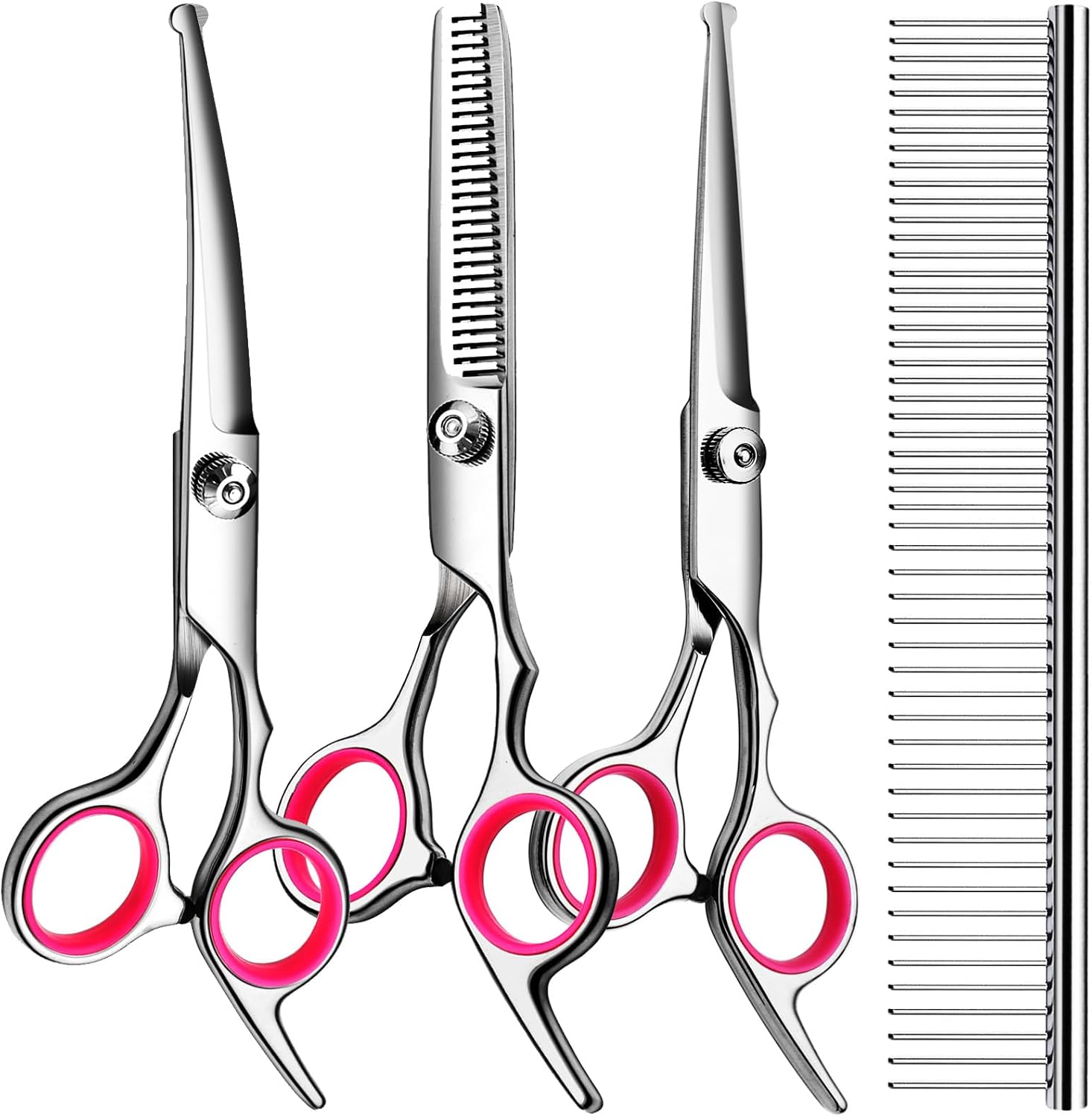
Budget pick: TINMARDA Dog Grooming Kit, Professional Stainless Steel Dog Grooming Scissors with Curved Shears, Pink Finger Rings - 4 Piece Sharp Durable Pet Shears for Dogs Cats At Home Salon-Quality Grooming
 Visit on Amazon →
Scissor work is the difference between a clip and a haircut. The curved pair in this set is the one that earns its keep: a curve lets you round a foot, shape a topknot, and trim around a face without flattening the coat into a bowl cut. The finger rings are not a gimmick either. A shear you can hold loosely with one finger in the ring is a shear you can drop instead of stabbing when the dog turns its head, and dogs turn their heads.
Stainless steel at this price will not hold an edge like a pro shear, and the tension screw will loosen over months of use, so keep the little wrench that comes with the set somewhere you can find it. Run the paper test before every groom. If the shear drags or pulls instead of slicing, tighten the screw a quarter turn and test again.
Flaws but not dealbreakers: You will outgrow these if you start grooming weekly, and the edge will need touching up. For trimming faces, feet, and sanitary areas once a month, they are more than enough, and you do not need a two-hundred-dollar shear to tidy around an eye.
Anyone grooming one dog at home who wants the finishing work to look intentional should have a curved pair in the drawer.
The setup around the two tools
The tools do not work alone, and none of the following needs to be fancy. You need a surface at waist height, because grooming on the floor wrecks your back and corners the dog, and a dog that feels cornered stops cooperating. A non-slip mat matters more than the table itself.
You need a slicker brush and a metal comb for the coat check, since a comb that will not pass through the coat is telling you the truth about whether the clipper can get through it either. You need ear cleaner and cotton pads, and you need to know that the cotton swab is the enemy: the canal is L shaped, and a swab packs wax deeper instead of lifting it out.
If you own a double-coated dog, a high-velocity dryer changes your life. If you own a doodle, a bath and a real dry after every clip is what keeps the coat from matting into felt. A human hair dryer is too hot and too weak, and it takes forty minutes to half-dry a lab. Skip it.
The actual workflow
This works on any dog with hair that grows continuously. Adjust the blade length for the coat in front of you, not for the picture you saw online.
Step one: read the coat before you plug anything in. Run a metal comb through the legs, the chest, and behind the ears. If the comb stops dead, you are not clipping, you are shaving, and that is a different conversation. Mats get shaved out and started over. No tool brushes a pelt apart, and anyone who tells you otherwise is selling a second appointment.
Step two: set up at waist height. Table, non-slip surface, and a loop or arm if you have one. The arm is safety equipment, not a restraint. A dog that panics on a table with a good arm stays on the table.
Step three: nails and ears first. Get the unpleasant work done while the dog is still fresh and still speaking to you. Trim or grind the nails, and clean only the visible part of the ear. Let the dog shake the cleaner out on its own.
Step four: sanitary trim before the body. Belly, rear, and the area around the face. This is the part nobody wants to talk about and every dog needs, and it is easier on a dog that has not already been clipped for twenty minutes.
Step five: body passes with the clippers. Work in the direction the coat grows, in slow overlapping passes, and let the blade do the cutting. Pushing the clipper through a coat is how blades get hot and how dogs get nicked.
Step six: rotate blades. This is the step that separates a good home groom from a bad one. Two blades in rotation beats one blade run hot. Touch the blade to the back of your wrist every few minutes. If it is too warm for your skin, it is too warm for the dog's belly.
Step seven: finish with the shears. Feet, face, and blending. Round the feet with the curved pair, tidy the topknot, and use small, quiet snips. Never scissor toward an eye, and never scissor a moving dog. Stop, reset, and start again when the dog settles.
Step eight: bath and dry in the right order. On a shedding coat, blow out the dead hair before the bath. On a curly coat, bath and then dry completely, because a damp doodle that air dries is a matted doodle by morning.
Where home grooms go wrong
Three failures account for most of the disasters I see. No table, so the dog is on the floor and learns it can leave. The wrong blade, usually a guard comb on a matted coat, where the comb pops off mid-leg and yanks hair instead of cutting it. And skipping the dryer, which is how a coat that looked fine at the end of the groom turns into a pelt a week later.
Two more worth naming. Blade burn is real and it is quiet: the dog does not scream, it just gets sore and starts flinching, and by then the damage is done. And daily use of a deshedding blade on a double coat cuts live topcoat. It is a tool, not a lifestyle.
If the dog's breath could knock you over, that is a vet visit, not a chew. If the ears smell yeasty and the dog is shaking its head, that is a vet visit too. Groomers are not diagnosticians, and the honest ones say so.
The honest math on home grooming
A home groom is not free, but it is not a salon visit either. You buy the clipper once, replace the blade when it dulls, and spend the time. The math changes the day you decide to groom weekly instead of monthly, because kit-grade motors and blades are built for one dog at a moderate pace, not for a professional schedule. If you are still grooming with a starter kit after a year of regular grooms, the tools are holding you back, and that is the moment to upgrade rather than the moment you get frustrated mid-leg.
The other half of the math is the dog. A groom that takes ninety minutes and ends with a relaxed dog is worth more than a faster one that ends with a dog that hides when you pick up the clippers. Take the breaks. Pay attention to the lip licks.
That is the job. Two tools, the right order, and a blade you would be willing to hold against your own wrist. Your dog will tell you if you got it right.